Australia's debt

mmm....shiney!

Administrator
Staff member
Silver Stacker
If you're an economics nerd and you have FB, then your feed has probably been inundated with pearl clutchers bemoaning the fact that Australia has reached the $1 trillion milestone in public sector debt.

Well, the simple way to look at it is that the public sector's debt is the private sector's asset.

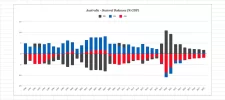
This is the sectoral balance sheet for Australia (projected out to 2028), I won't vouch for it's accuracy, it just shows that when the government (GB) balances are negative, the private sector (PB) balances are in credit. There's also foreign balances (FB) represented but the two interesting parts of the chart are firstly the period where Costello was purportedly exercising rational economic policy in the period 1996 - 2007, and contrasting with that is the COVID spening measures of the early 2020's. When a government runs a fiscal deficit, the private sector benefits , when a government runs a fiscal surplus, it removes more money from the economy than is being circulated.Screen-Shot-2023-07-26-at-4.26.05-pm.webp
 
Last edited:
Then in order for the Gov to cancel out the debt (that they have accrued as fiduciary's), they'd be eyeing off all of that private sector capital, to right the ship?
 
Then in order for the Gov to cancel out the debt (that they have accrued as fiduciary's), they'd be eyeing off all of that private sector capital, to right the ship?

Are you referring to the Federal or State's debts?

If it's the Fed debt then no. It doesn't need private sector funds to meet any obligations when it comes to managing Treasury Securities because it creates its own money supply. Remember, the "debt" doesn't really exist. The government just exchanges promises on pieces of paper (bonds and notes) for money that is already in existence. And when it's time to pay the yield it just creates money out of thin air to meet its obligations and the matured bonds and notes aka "existing debt" is destroyed. So when it issues debt, it's exchanging one form of money (currency) for another (notes and bonds). It's not actually creating any new money. It creates new money when it spends on its suppliers, employees and welfare recipients.

If you're referring to the States then I don't know anything about that. Presumably the States do not have the power to seize the assets of the private sector en masse. Do you have a link to any policy discussions that may indicate that that is a possibility?

Fuck, I sound like google AI. :D

In the end, none of the States will go bankrupt because the Feds can bail them out.
 
Last edited:
MMT is deeply flawed, and I’m continually amazed that anyone still buys into it. Mind you, given this forum leans heavily left and thinks fiscal geniuses like Albo have it all figured out, I suppose I shouldn't be surprised.

The biggest trick the MMT pulls here is confusing a retrospective accounting identity with an actual economic benefit. Just because a spreadsheet balances at the end of the financial year doesn’t mean the real-world economy is healthy or prosperous.

Think about what that $1 trillion debt milestone actually means. The government doesn't have its own money—every cent of public debt is just a future tax liability on Australian citizens and businesses. We are already burning billions of dollars every single year just to service the interest on that debt, much of it flowing straight to foreign bondholders. That’s money directly stolen from future public services or added to our tax bills down the road.

In reality, the "private sector benefit" (as if a labor govt would ever do such a thing, ridiculous suggestion to begin with) is an absolute inflation trap. When the government pumps cash into an economy running at full employment, it doesn't create wealth—it just bids up prices. The private sector might have more "units" of currency on paper, but our purchasing power has been completely eroded. Inflation is just a hidden, regressive tax that hits working people the hardest.

Second, MMT completely ignores what the debt is actually buying. Deficits can occasionally be justified if they build productive infrastructure or drive future growth. But under the current Albanese muppet show, we’re just watching private savings get swallowed up to fund government consumption and bureaucratic bloat, completely crowding out the private innovation that actually builds an economy.

Finally, the MMT happily ignores the foreign factor. Australia is historically a capital-importing nation. When Canberra runs massive deficits, that "credit" on the other side of the ledger doesn't neatly land in the pockets of Aussie households. A huge chunk of it flows straight overseas to foreign investors buying our debt. The domestic private sector gets left holding the bag for the liability, while overseas funds reap the yields.

So is it really "pearl-clutching" to worry about a trillion dollars of debt when our purchasing power has demonstrably gone to the crapper amidst rampant inflation? I think not.
 
The $1T debt is predominantly post Howard. Equal parts left and right. We can blame it on the GFC and Covid if we like but whatever, it’s ours now.
We can handwring or endeavour to do something about it. I believe that “they” intend to inflate it away. Meanwhile “we” must stay on the upper stem of the K economy and pontificate to the bottom stem!
 
Back
Top