If you're an economics nerd and you have FB, then your feed has probably been inundated with pearl clutchers bemoaning the fact that Australia has reached the $1 trillion milestone in public sector debt.
Well, the simple way to look at it is that the public sector's debt is the private sector's asset.
This is the sectoral balance sheet for Australia (projected out to 2028), I won't vouch for it's accuracy, it just shows that when the government (GB) balances are negative, the private sector (PB) balances are in credit. There's also foreign balances (FB) represented but the two interesting parts of the chart are firstly the period where Costello was purportedly exercising rational economic policy in the period 1996 - 2007, and contrasting with that is the COVID spening measures of the early 2020's. When a government runs a fiscal deficit, the private sector benefits , when a government runs a fiscal surplus, it removes more money from the economy than is being circulated.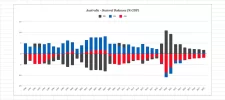
Well, the simple way to look at it is that the public sector's debt is the private sector's asset.
This is the sectoral balance sheet for Australia (projected out to 2028), I won't vouch for it's accuracy, it just shows that when the government (GB) balances are negative, the private sector (PB) balances are in credit. There's also foreign balances (FB) represented but the two interesting parts of the chart are firstly the period where Costello was purportedly exercising rational economic policy in the period 1996 - 2007, and contrasting with that is the COVID spening measures of the early 2020's. When a government runs a fiscal deficit, the private sector benefits , when a government runs a fiscal surplus, it removes more money from the economy than is being circulated.
Last edited: