Why the Aussie won't go down

Dogmatix

Active Member
An interesting article from FNArena about the AUD - worth reading IMO.

From: http://www.fnarena.com/index2.cfm?type=dsp_newsitem&n=004A72E9-DE86-E6FE-B57D7CFCA0FDAC35

Why The Aussie Won't Go Down
FNArena News - September 26 2012

By Greg Peel

Prior to about the last twelve months, the Aussie dollar has always traded as a "risk currency", reflecting price movements in our major exports commodities. Yet more recently, commodity prices have fallen and the Aussie has remained elevated above parity. The common explanation is that while yields on Australian bonds are low by Australian standards, they are still world-beating on a AAA-rated basis compared to yields in the US, Europe, UK, Japan and elsewhere. The world has been parking its money downunder.

A couple of points to note here.

The first is regarding what I believe is a common misconception outside of forex dealing rooms. In dealer-speak, the word "dollar" refers only to the US dollar. The nickname "Aussie", by itself, refers to the Australian dollar. Thus when we say the "Aussie dollar" exchange rate, we mean the Australian dollar to the US dollar, and the "dollar" in "Aussie dollar" refers to the greenback.

The second is that while the Aussie has long been a commodity currency, the correlation of movement is still a reflection of interest rate differentials. If commodity prices rise, Australia's GDP should rise, then the RBA will put up rates, and thus we have a greater interest rate differential to the US (assuming we fix the US). It's just that the final outcome is a slow moving one, and forex traders are fast movers.

On that basis, we would have expected that as commodity prices have fallen in 2012, and most notably the iron ore price over recent weeks, the Aussie dollar should have fallen. Lower commodity prices imply lower GDP growth and lower RBA rates, leading ultimately to a lower interest rate differential (particularly as the Fed has now extended its "zero" rate to mid-2015). But the yield on an Australian government AAA-rate two-year bond is 2.5% and the equivalent (AA+) yield in the US is 0.25%, with both country's inflation rates around the 2% mark. Even if the RBA cuts again, the differential will remain attractive to big low-risk funds looking for any sort of positive return.

It is for that reason Australia has been recording record foreign ownership ratios of Aussie bond holdings of late. The world has been lending Australia money against its current account deficit like never before. And commentators have cited these inflows as the obvious reason why, despite weak commodity prices, a weak global economy, and particularly a slow China, the Aussie just won't fall. It all makes perfect sense.

Only problem is, the explanation is incorrect.

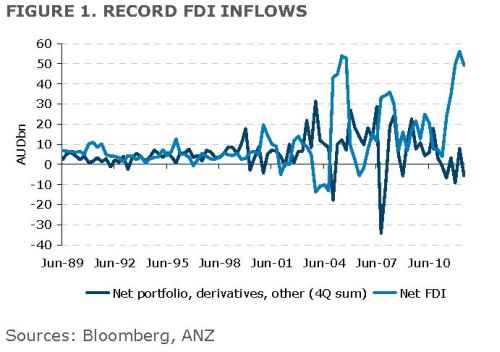
The following chart from the ANZ Bank foreign exchange analysts tells the true tale:
0_8_fdi(2).jpg


The dark blue line represents net in/outflows of foreign portfolio allocations to Australia. The light blue line represents foreign direct investment (FDI). The former represents financial instruments such as bonds and stocks, and the latter represents "real" assets such as, most notably, mines. We see that net flows have actually been negative most recently, despite record foreign bond purchases. FDI, on the other hand, has gone to the moon.

ANZ points out that one cannot isolate "naked" foreign purchases of Australian bonds alone. There are more elements to the greater funds flow equation. For one, it appears a lot of those bond positions have been hedged using derivatives (such as futures positions), which provide an offset. Then there's the small matter of the Australian stock market's underperformance to Wall Street. Americans might be buying bonds but they are also withdrawing from Australian stocks. And finally, Australia's banks have been reducing their dependence on offshore funding (eg issuing bank bonds in the US) and building up their domestic deposit bases instead. This again results in reduced inflows.

At the end of the day, foreign portfolio allocations do not justify the strong Aussie dollar.

But the FDI "boom" is historically significant as it has provided Australia with its first "basic balance surplus" since the early 1970s, ANZ notes. Another lesson is required here.

The surplus Wayne Swan is so determined to provide this financial year is a budget surplus the balance of government inflows (eg taxes) against outflows (eg welfare) in one financial year. Each month we also take note of the trade balance, being the balance of export receipts and import payments in that month. If the former is greater than the latter, it is a surplus for the month. These are two different "surpluses".

Even if both of the above are in surplus, Australia is still running, and has been for a long time, a current account deficit. This implies that after netting both the public and private sectors, we are in a net debt position. The US runs a current account deficit, on a scale that is difficult to even fathom. China, as an exporter of manufactured goods, runs a current account surplus. Most of that surplus it lends to the US.

The "basic balance" equals the current account plus FDI. Countries currently running a basic balance surplus include Norway and Switzerland. Japan used to, but not recently. Australia hasn't since the early seventies (the time of another mining investment boom) but it is now.

If a Chinese-Japanese consortium wishes to buy Cubby Station, it must pay in Australian dollars. The consortium must thus "buy" Aussie before it hands over the cheque. The reserve currency (US dollar) is the currency of international transactions. Every new foreign stake in an Australian asset will incrementally force the Aussie higher. It works the other way when Australian companies acquire stakes in offshore assets, which they do, but as the graph above shows, net flows are very much weighted inward at present, not outward.

That's why the Aussie dollar is so strong. And the bad news is, it's also why we can't expect any meaningful move to the downside in the short term, no matter what the RBA does.

It is "almost unheard of," notes ANZ, for a commodity exporter to run a basic balance surplus. A basic balance surplus currency will tend to be reasonably stable, the analysts point out, and less cyclical, than the currencies for which portfolio flows dominate the capital account. Sound familiar? (Note that the current account equals the capital account plus the trade balance).

Foreign portfolio allocation decisions can turn on a dime. Foreign direct investment in Australian mining projects represent long term investment decisions, requiring constant inflows of foreign currency to cover the cost of development. FDI does not respond to day to day newsflow, notes ANZ, nor even to monetary policy decisions in the short term. The Aussie is now trading, and will continue to trade, with a lack of volatility. There will be no sudden collapses, such as that which we saw in 2008. Movements up and down will be smooth and balanced. After taking a closer look at FDI, ANZ has decided the Australian dollar is unlikely to weaken substantially against the US dollar until after the FDI pipeline has turned sharply lower, which at this stage would not be until at least mid to late 2013.

On that basis, all this speculation about whether the RBA will cut rates next month, or at least before year-end, based solely on the currency, is moot.

Were a punter wishing to establish a currency trade based on RBA expectations, one would be best to play the crosses. ANZ suggests selling the Aussie against the Kiwi if you want to back a rate cut. Selling the Aussie dollar will get you nowhere in a hurry.
 
...is it just me..or the beer.... did the last half of the article drift off into gobble-dee-gook ?
 
Aah. Good old X-M = S-I with the exchange rate acting to clear the markets. Simple really. One of the fun things is that movements in the real exchange rate are changes in our terms of trade (i.e. export a different amount of our stuff to trade for their stuff - where "stuff" excludes money trades).
 
My analysis of the AUD is the opposite of Mr Peel.

The governments attempt at returning to surplus (as a big of a joke as that is) would mean that even though there is demand for government bonds, the actual availability of those bonds will not be changing. If a coalition get in it will be the same (the public has had enough of the credit card being racked up). So while the demand may be there, if the net debt is not increasing, the AUD has no where to really go as more bonds will not be entering circulation. The yield may certainly drop on the current ones in circulation/rotation forcing down the interest rate which is good for Australia.

The other part of the analysis above suggests the commodity prices and account deficits..... Does anyone here really think our commodity prices are heading north and our account surplus will do the same (Bullish on the AUD) or is it more likely commodity prices continue to ease and the account deficit grows back to long term norms now we don't manufacture anything (bearish on the AUD)?

I am going with sub 95c sooner rather than later.
 
Lovey80 said:
I am going with sub 95c sooner rather than later.

You got an approximate time frame there lovey? No pressure, just curious.

Of course, if commodity prices continue to fall, then it's good bye to 21 years of growth, that's gonna hurt. And the word out of The Senate today (from the Lips of a Liberal, disgusting thought really :P ) is that the Government will get the theasaurus out and start prepping us for a budget deficit. Chanbge a few words here, insert some synonyms, don't mention the "s" word ever again, (that's "surplus" for you slower types ;) ) and Hey Presto!!!!!!! We've justified the necessity to return a budget deficit. :)

You could always call it a "Comparative Surplus" swannie. You know? Compared to Greece we're, compared to Portugal we're......
 
mmm....shiney! said:
Lovey80 said:
I am going with sub 95c sooner rather than later.

You got an approximate time frame there lovey? No pressure, just curious.

Of course, if commodity prices continue to fall, then it's good bye to 21 years of growth, that's gonna hurt. And the word out of The Senate today (from the Lips of a Liberal, disgusting thought really :P ) is that the Government will get the theasaurus out and start prepping us for a budget deficit. Chanbge a few words here, insert some synonyms, don't mention the "s" word ever again, (that's "surplus" for you slower types ;) ) and Hey Presto!!!!!!! We've justified the necessity to return a budget deficit. :)

You could always call it a "Comparative Surplus" swannie. You know? Compared to Greece we're, compared to Portugal we're......

I do have a time frame in mind but I will keep it to myself as always. I am actually surprised looking at just our figures that the Aussie is still so high, it's a joke really... Then I have a look at who we are being compared to and give myself an uppercut for being surprised in the first place. Then next wayne swan is just around the corner *cough* I mean black swan and that should give us a very good shake up.

Labor may actually return us to surplus, but you can bet your ass they will get called out by the coalition and every person that can count to 10 that looks at the figures for cooking the books like they always do. Giving a national budget to the Labor party is akin to giving the keys of a small business petty cash tin to a junkie. Sure the receipts may add up after some threats of sacking for shortfalls, but you can guarantee the receipts are there just for show.
 
Today's Forex Daily Outlook was interesting:

New Zealand Dollar:

While the big news and major market mover over the last 24 hours has been the US election we did see some action locally yesterday with the release of the RBNZ biannual financial stability report. In the report Governor Wheeler basically said they were effectively powerless to a rising NZD in that lowering interest rates were unlikely to cause any lasting fall, while QE would be a sign of desperation. The kiwi initially fell 30 points towards 0.8240 off the release but the losses were quickly regained as the results of the US election began to flow through. The NZD/USD managed to break 0.83 before following other risk related assets lower after a report out of Europe showed lower growth forecasts for the Eurozone countries. This morning we find the NZD relatively unchanged from yesterday's open currently at 0.8260 with local employment data due out shortly.

We expect a range today of 0.8290 0.8220

Just putting on my de Bono Purple Hat (The paranoid one with eyes stuck to the back of it), do you think it possible at all the US would pressure Central Banks in countries that are its Allies to not pursue QE or ZIRPs? This of course does not include Britain, but nearly every move the US has made on the world stage since WWII has had the full support and involvement of Britain in it's planning stages.
 
There is an increasing number of australian bond sellers entering the market with the appetite increasing in australia, traditionally not a bond buying community
 
mmm....shiney! said:
Today's Forex Daily Outlook was interesting:

New Zealand Dollar:

While the big news and major market mover over the last 24 hours has been the US election we did see some action locally yesterday with the release of the RBNZ biannual financial stability report. In the report Governor Wheeler basically said they were effectively powerless to a rising NZD in that lowering interest rates were unlikely to cause any lasting fall, while QE would be a sign of desperation. The kiwi initially fell 30 points towards 0.8240 off the release but the losses were quickly regained as the results of the US election began to flow through. The NZD/USD managed to break 0.83 before following other risk related assets lower after a report out of Europe showed lower growth forecasts for the Eurozone countries. This morning we find the NZD relatively unchanged from yesterday's open currently at 0.8260 with local employment data due out shortly.

We expect a range today of 0.8290 0.8220

Just putting on my de Bono Purple Hat (The paranoid one with eyes stuck to the back of it), do you think it possible at all the US would pressure Central Banks in countries that are its Allies to not pursue QE or ZIRPs? This of course does not include Britain, but nearly every move the US has made on the world stage since WWII has had the full support and involvement of Britain in it's planning stages.

Yes, definitely, and particularly Australia.

Maybe not so much in larger economies.

Whether it is coercive, our just misleading economic theory, I think it is very possible. Look what we did with the stimulus, cash for clunkers, etc. 52nd state much?
 
You don't want a bono purple hat these day..What you need is a tartan coloured hat like a wee Highlander. :)

Regards Errol 43
 
I think a lot of what happens here is determined internationally.

There's no other reason that in a country which is supposed to be one of the wealthiest western economies in existence, weathering the calamity of the 2008 flash crash well and kept bouyant by being a resource 'boom' should have gone from 20 billion in public surplus to around 250 billion in the red 4 years later.

Party politics shouldn't even come into it.

We might have the best view of the world on the global shit sandwich, but it's still a shit sandwich at the end of the day and I think people are very forgetful of that fact.

We still operate under a multispeed economy with a strongly slowing retail sector, increasing layoffs & business bankruptcies and a dwindling domestic manufacturing base.

The central bank here are moving towards a cheap credit policy to bail out the debtors, knowing that cheap money will simply lead us down the path of international economics - albiet somewhat slower.

How can anyone who's even remotely awake still believe 'it's different here' and that we're immune to what's coming in the international markets?

About the only thing Australia might have an edge on is just how full of shit our political leaders are and how willingly out stupid populace buys the story they're being told.

Juliar slapped on one of the most enslaving taxes on any nation in the breathing tax (after swearing she wouldn't) and the idiot population here are actually considering voting for her next year... the 'lesser' of two evils over big ears?

When the international ship goes down, we go down with it - end of story.

People need to take off the blinkers and start facing objective reality before it bitchslaps you back to the dole queue.
 
errol43 said:
You don't want a bono purple hat these day..What you need is a tartan coloured hat like a wee Highlander. :)

Regards Errol 43
Equity investors will be wearing brown undies....
 
Auspm said:
I think a lot of what happens here is determined internationally.

There's no other reason that in a country which is supposed to be one of the wealthiest western economies in existence, weathering the calamity of the 2008 flash crash well and kept bouyant by being a resource 'boom' should have gone from 20 billion in public surplus to around 250 billion in the red 4 years later.

Party politics shouldn't even come into it.

We might have the best view of the world on the global shit sandwich, but it's still a shit sandwich at the end of the day and I think people are very forgetful of that fact.

We still operate under a multispeed economy with a strongly slowing retail sector, increasing layoffs & business bankruptcies and a dwindling domestic manufacturing base.

The central bank here are moving towards a cheap credit policy to bail out the debtors, knowing that cheap money will simply lead us down the path of international economics - albiet somewhat slower.

How can anyone who's even remotely awake still believe 'it's different here' and that we're immune to what's coming in the international markets?

About the only thing Australia might have an edge on is just how full of shit our political leaders are and how willingly out stupid populace buys the story they're being told.

Juliar slapped on one of the most enslaving taxes on any nation in the breathing tax (after swearing she wouldn't) and the idiot population here are actually considering voting for her next year... the 'lesser' of two evils over big ears?

When the international ship goes down, we go down with it - end of story.

People need to take off the blinkers and start facing objective reality before it bitchslaps you back to the dole queue.
If anyone gets "bitchslapped " back to the dole queue is there anything they can do about it ?

You live in such a doom & gloom world .
 
renovator said:
If anyone gets "bitchslapped " back to the dole queue is there anything they can do about it ?

You live in such a doom & gloom world .

It's not a question of Doom & Gloom as much as being realistic about the situation.

How could anybody in their right mind trust the assurances of our politicians or head of the RBA who are on record for being pathological liars?

I'm just saying that this country has a severe case of irrational exuberance and judging by what has pulled down this country's economy in the past, I'm lamenting the fact that this time anyone thinks it might be different.

We ride the coat tails of the industrial world. If they go down, we go down along with them.

Or doesn't anyone remember the all out panic in this country back in 2008?

Government of the day blew our entire surplus in a panic and now look where we sit.

Where's our manufacturing base gone?
Where's the future influx of trade coming from to reignite our flagging economy?
WHO is going to even be able to pay for it?

We have 20% of the populating moving from net tax payers to next tax takers in the next 5 years and absolutely nothing in our economy upcoming that will be able to account for this loss of public income (except maybe further propped up house prices?)

Meanwhile, we have politicians throwing cash at the most ridiculous public works programs whilst our core industries and infrastructure rot with the ONLY 'solution' on the table being more taxation!

Doesn't sound like a very secure economy to me at all... which is why so many international management funds are starting to short this country and it's banks I think.

I'd rather think for myself, regardless of what people might call me Reno and everything I've seen without the rose coloured glasses on tells me we might be very well living in a fantasy in this country, whilst some very serious storm clouds gather on the horizon.

Everytime someone comes out and proclaims 'it's different here' I seriously want to cringe...
 
Auspm said:
How can anyone who's even remotely awake still believe 'it's different here' and that we're immune to what's coming in the international markets?

Agree.

But why won't the AUD go down as many here have predicted over the past 12 months?

It is different enough to keep the AUD at or above parity for for much of the past two years. 18 months ago I would've thought the AUD would be in the 90-95cUSD range, but we're not, mostly due to the USD Fed's manipulations. I was hoping the AUD would devalue, for some personal reasons and also because our economy is in dire straits and needs a weaker $ because that's the only game in town now. The only way I see the AUD tanking is when the USD finally collapses, and then it won't matter.

@lovey or anyone else, re: bonds. Can you please explain this chart to me in normal language and any impact it has on the AUD/USD? I understand the blue line to be turnover, and the bars to be turnover ratio, turnover has been rising for a number of years, the turnover ratio has been fairly static. What does it all mean and has this got anything to do with a high AUD?

[imgz=http://forums.silverstackers.com/uploads/753_treasury_bond_maturity_9nov.jpg]
753_treasury_bond_maturity_9nov.jpg
[/imgz]
 
^ totally agree with you, except for the bust part

I think if there is an event that causes our banks and industry to suffer (pop the property bubble, etc), then there will be a panic rush out if the AUD.

Although it may also be dependent on China.

A US financial collapse would do it too.

Basically any economic event that would cause a panic out of the AUD. Once the panic builds momentum, how can we bring the AUD up again?
 
Dogmatix said:
^ totally agree with you, except for the bust part

Which bit are you referring to doggie?

Edit to add: Nah, I understand, you're saying that there are more ways for the AUD to tank than just the one I'm referring to.
 
Back
Top