The Case for Private, Programmable Digital Cash

All good

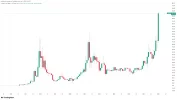
On the topic of 'privacy coins' by the way, the chart for Monero looks very similar (compressed version) to the chart of silver in USD over the past 50 years. Breakout would have a positive flow on effect across the entire privacy coin space IMO.

View attachment 98420
Beautiful breakout on the Monero chart and as expected it has renewed interest in privacy coins.

Tari is up 50% since the original post in this thread and it's heading a lot higher IMO...

1768384954456.webp
 
Part of Gresham's Law that states:
- When two forms of currency with the same face value circulate, people hoard the more valuable "good" money and spend the less valuable "bad" money.

A point to the side of bad is: higher rate of inflation.
So when 2 forms of fiat are "of the same value" (i.e: simply because of an exchange rate between them)
The one thats inflating the most is less hoarded and actually used as currency (economicly spent / circulated + returned to the issuing financer).

other points to the side of "bad" are:
- poor divisability, fungability or physically decays over time.
- is of no other practical use other than as an exchange medium.
- is bulky, or otherwise burdonsome/a risk to carry/possess or hold long term.

But mostly, inflation is partly supportive of making fiat usefull as it supports its circulation and not its hoardability.
Nonbody is going to short squeeze fiat paper that can, and is, printed to infinium... unless:
- theres a return on the holding (interest rates) - {note: this grants a measure of system control by issuing financers}
- your able to hold negative values that depricate your debt rather than credit over time (again: interest rates as a control mechanism)
- can be used with leverage to increase its purchase power. (which is in part reliant on a financer anyhow whose terms mostly invlove extra risks and interest or a gample such that its in their favor to actually lend) - {i.e you cant just "buy a house", on forex with 20:1 leverage, and not actually pay interest on a loan..... but you can with gold, silver, bitcoin and even exposure to other currencies...}

so money supply base increase is important to support currency being less valuable than the stores of value, and to position it as a medium of exchange that is otherwise ~worthless.

and tax...
because inflation causes relative capital gains to any other better money.
Gresham's Law applies when two forms of currency with the same face value circulate. Face value is enforced by decree (fiat). It does not apply just because two monies have an exchange rate between them. A classic local example is the hoarding of round 50 cent pieces.

It is also a descriptive observation rather than a prescriptive law. The corollary is that in a free market, a vendor will choose to either accept only the good money, or accept the bad money at a discount (as happened with the trading of frozen bank account balances during the Great Depression). This is known as Thiers' Law.

Reverse of Gresham's law (Thiers' law)​

The experiences of dollarization in countries with weak economies and currencies (such as Israel in the 1980s, Eastern Europe and countries in the period immediately after the collapse of the Soviet bloc, or Ecuador throughout the late 20th and early 21st century) may be seen as Gresham's law operating in its reverse form (Guidotti & Rodriguez, 1992) because in general, the dollar has not been legal tender in such situations, and in some cases, its use has been illegal.<a href="https://en.wikipedia.org/wiki/Gresham's_law#cite_note-22"><span>[</span>22<span>]</span></a>

Adam Fergusson (in: When Money Dies) and Costantino Bresciani-Turroni (in Le vicende del marco tedesco, published in 1931) pointed out that, during the great inflation in the Weimar Republic in 1923, as the official money became so worthless that virtually nobody would take it, people simply stopped accepting the currency in exchange for goods. That was particularly serious because farmers began to hoard food. Accordingly, any currency backed by any sort of value became a circulating medium of exchange.<a href="https://en.wikipedia.org/wiki/Gresham's_law#cite_note-23"><span>[</span>23<span>]</span></a> In 2009, hyperinflation in Zimbabwe began to show similar characteristics.

Those examples show that in the absence of effective legal tender laws, Gresham's law works in reverse. If given the choice of what money to accept, people will accept the money they believe to be of highest long-term value and not accept what they believe to be of low long-term value. If not given the choice and required to accept all money, good and bad, they will tend to keep the money of greater perceived value in their own possession and pass the bad money to others.

In short, in the absence of legal tender laws, the seller will not accept anything but money of certain value (good money), but the existence of legal tender laws will cause the buyer to offer only money with the lowest commodity value (bad money), as the creditor must accept such money at face value.<a href="https://en.wikipedia.org/wiki/Gresham's_law#cite_note-Rowe-24"><span>[</span>24<span>]</span></a>[<em><a href="https://en.wikipedia.org/wiki/Wikipedia:Reliable_sources" title="Wikipedia:Reliable sources"><span title="The material near this tag may rely on an unreliable source. blog posts are generally not reliable sources (November 2022)">unreliable source?</span></a></em>]

Nobel Prize winner Robert Mundell believes that Gresham's law could be more accurately rendered, taking care of the reverse, if it were expressed as: "Bad money drives out good if they exchange for the same price."<a href="https://en.wikipedia.org/wiki/Gresham's_law#cite_note-25"><span>[</span>25<span>]</span></a>

The reverse of Gresham's law, that good money drives out bad money whenever the bad money becomes nearly worthless, has been named "Thiers' law" by economist Peter Bernholz in honor of French politician and historian Adolphe Thiers.<a href="https://en.wikipedia.org/wiki/Gresham's_law#cite_note-26"><span>[</span>26<span>]</span></a> "Thiers' Law will only operate later [in the inflation] when the increase of the new flexible exchange rate and of the rate of inflation lower the real demand for the inflating money."<a href="https://en.wikipedia.org/wiki/Gresham's_law#cite_note-27"><span>[</span>27<span>]</span></a>
Source: wikipedia

But mostly, inflation is partly supportive of making fiat usefull as it supports its circulation and not its hoardability.
Why does money need to be supported in its circulation? If it is good money, then let Thiers' law do its thing and circulation will take care of itself.
 
And then there’s risk.
As we saw during c19 bank accounts were frozen in Canada
Moving on, Russian assets were confiscated
Further down the track. USA government accumulation of BTC from seizures
And most recently, millions of Vietnamese citizens had their bank accounts blocked.
As we can see, digital is fantastic for those that control it
 
Back
Top