Question to Exchange Traded Fund shareholders

Pirocco

Well-Known Member
I wonder, in my Kitcomm past I saw quite alot people indicating in their post that they had silver ETF shares.
Is that here also the case? Who here had or has ETF shares, and what's your story (when did you buy them and why, when did you sell them and why, did you hold, why?
I'm interested because I find it remarkable that silver ETF's still hold nearly all the silver they accumulated (since 3 years), while their gold equivalents sold big time (over half).
Another reason is that I discovered a remarkable element in silver data accumulated over the years, weird enough to justify a closer look.
So if you have a silver ETF related story, and wanna share it (whole or partly, details as you wish), go ahead.
 
The stock reports shows them sitting on 600 Moz silver, over half on an entire world supply, but they hide!
Or would they not exist? :D
Anyone here has ETF shares?
Anyone?
Hello?
Nobody? :D
 
I don't hold any ETF shares.

If I did, it would only be physical ETFs, and not those based on futures or derivatives.
 
I like both SLV and GLD because of the ease of buying and selling with a few clicks.
Not being in the target audience of present-day bullion marketing I have little fear of 'paper' gold and silver.
I bought a large position in SLV in late 2008 at about $10/share and sold all early in 2011 at about $30/share.
I have a small position in GLD that I trade in and out of occasionally. I think gold has been overpriced for a long time.
I believe I can make it to the finish line without having to selling any of my physical precious metals, I'll let my estate deal with it.
 
See, that's the big absence, early 2011, when I bought silver for the 1st time, I saw people talking about their SLV shares, but that ceased, then I read people talking about their sales of shares, and I remember a case where one lost quite some money in the may 2011 dump. But 2012 onwards, it became a no talk about'er.
Yet, the amount silver in their stocks is even bigger than then. There are people in the world owning shares that are backed by 600 Moz silver in depositories.
And about ease of buying and selling of ETF shares, yes, that's is named as a big advantage, yet, considering the rather smallish fluctuations of the ETF stocks (the min/max of the last 2 years differs only 8%) relative to the price fluctuations, apparently few actually use that 'big advantage'.
 
Sure, but my advice would be to stick to 100% physical-backed - not all are - and go to some lengths to check they really are.

Are they audited? Can you convert to physical? Etc.
 
My question, and this topic, is totally about the physical backed ETF's.
The others, based on futures, are reflected in the Comex position, so monitored along that.
 
House said:
Pirocco, do you buy gold at all?
No.
Is that relevant here?
I like to have an idea about what silver ETF (former) shareholders thought/think.
Because I like to find an explanation as to why the silver ETF stocks didn't drop like golds earlier last year. A 50% stock drop of gold ETF's and no drop in silver ETF's. It's a weird difference, considering that both price trends were the same.
 
I use a gold ETF as part of my stock portfolio weighted at 5%. It is only a stabiliser. This is what most gold ETF holders reason is. If you want to speculate on gold prices and try and make money, you go to the geared futures market.

I have also been pondering purchasing a silver ETF if spot dips low enough, then slowly trade off for physical holdings so I assist my physical holdings by locking in a speculative low price. Price would probably need to get to near $15 US spot for me to do this though as Aussie Silver ETFs are very illiquid.

Pirocco said:
Because I like to find an explanation as to why the silver ETF stocks didn't drop like golds earlier last year. A 50% stock drop of gold ETF's and no drop in silver ETF's. It's a weird difference, considering that both price trends were the same.

A silver ETF will have exposure to silver in equilibrium to the equity from their shareholders. If a gold ETF is selling off their exposure while a silver one isn't it just means that the gold one is losing shareholder numbers while the silver one is not. Unlike a company stock which has a finite amount of shares issued an ETF can create and remove blocks of stocks at will. If their holders drop off then they will down size accordingly. Is this what you talk about?
 
With SLV and GLD you know exactly what your holdings are worth at any given time.
Trying to calculate the worth of your holdings in physical metals is much harder. Just the math is a hassle.
Do you plan on selling at spot, or must you calculate in the premiums for collector coins? Do you know exactly where you are going to sell your items?

According to the financial genius (YouTube variety) Mr. Gregory Mannarino: if everyone sold their gold and silver ETFs at the same time the price would go to zero.
Perhaps you have heard, once or twice, the phrase: 'if you don't hold it, you don't own it'. This is why I carry the deeds to my real estate in my back pocket.
 
hilaire9 said:
According to the financial genius (YouTube variety) Mr. Gregory Mannarino: if everyone sold their gold and silver ETFs at the same time the price would go to zero.
Perhaps you have heard, once or twice, the phrase: 'if you don't hold it, you don't own it'. This is why I carry the deeds to my real estate in my back pocket.

This is true in theory. In practice, they need to do it in stages by redeeming large blocks of shares, offloading their exposure and writing off the sellers. Outside of the redeeming process you are still limited to the liquidity of a buyer matching to a seller just like a normal stock. So it is not possible for this to happen all at once. And the EFT will only be at zero because there are no shareholders and hence no exposure to anything.
 
BiGs said:
I use a gold ETF as part of my stock portfolio weighted at 5%. It is only a stabiliser. This is what most gold ETF holders reason is. If you want to speculate on gold prices and try and make money, you go to the geared futures market.
Gold ETF shareholders dumped half their shares during 2013 Q1 + a few months. The biggest drops occurred during the days of the big price drop. I came across articles (also posted on this forum) mentioning about 3 large fund holders names, which suggests a few big fish. If they had the same 'stabiliser' purpose as you, then that would mean that they didn't need the 'stabiliser' part in their 'portfolio' anymore, so they must have also dumped the product/derivative/whatever they were using gold ETF shares as other side of the balance. Actually, what you name 'stabiliser' here, is hedging. Where did they stop hedging against? The counterside of the gold was? Which inverse risk to gold ceased to exist, that didn't exist for silver?
Also, what's the difference between hedging and speculating? And how does it matter? In the end, this is about some money that is being swapped between markets; and speculation as well as hedging are two things that are bound together, since a gain side implies a loss side, and both sides are thus acting against eachother.

BiGs said:
A silver ETF will have exposure to silver in equilibrium to the equity from their shareholders. If a gold ETF is selling off their exposure while a silver one isn't it just means that the gold one is losing shareholder numbers while the silver one is not. Unlike a company stock which has a finite amount of shares issued an ETF can create and remove blocks of stocks at will. If their holders drop off then they will down size accordingly. Is this what you talk about?
Of course, otherwise the price of the derivative (ETF share) wouldn't track the price of the underlying (gold, silver), they would become 'separate' markets and unable to chew out money from the market of the underlying, so a zero sum market on their own, thus a smaller one, causing less to 'gain'. And no, what I talk about is why gold ETF shareholders dumped, while silver ETF shareholders didn't. There must be a difference somewhere.
 
hilaire9 said:
With SLV and GLD you know exactly what your holdings are worth at any given time.
Trying to calculate the worth of your holdings in physical metals is much harder. Just the math is a hassle.
Do you plan on selling at spot, or must you calculate in the premiums for collector coins? Do you know exactly where you are going to sell your items?
I calculate my silver by its ounces.
That's not that hard eh.
Why should I use euro's?
The reason I swapped euro's to silver is exactly to be more sure about what I have.
hilaire9 said:
According to the financial genius (YouTube variety) Mr. Gregory Mannarino: if everyone sold their gold and silver ETFs at the same time the price would go to zero.
Perhaps you have heard, once or twice, the phrase: 'if you don't hold it, you don't own it'. This is why I carry the deeds to my real estate in my back pocket.
That financial guru should then also add that this requires a second condition: nobody buying at that time. And with IFs one can make any conclusion, including a square planet.
And owning along a third party is also owning, it just adds a dependency on that third party. So it's more about independency than owning.
 
BiGs said:
...as Aussie Silver ETFs are very illiquid.
What you ment with this?
Because I saw many stating that they chosed ETF shares because of their quick and easy buy/sell (matters when trying to milk others by the element speed).
 
Pirocco: The consensus reasons for being in a gold ETF is different to the consensus reasons for being in a silver ETF. These investors could of changed to another ETF, or moved to derivatives, or physical gold, or silver, or just changed their stratagy, who knows. Don't look at one ETF and think it represents all gold investors.

When I say my gold is a stabaliser I mean the divergence from normal markets calms the long term ebbs and flows. When my gold weighting hits 6% i sell back to 5%, 4% and I buy back to 5%. It has some hedging effects too but it really 'stabilises' my portfolio and is a common practice among investors and even hedge fund managers.

The buying and selling in an ETF still has to match buyers with sellers. The creating and redeeming process only happen when enough imbalance occurs. When I say illiquid I mean that the ETF is rarely traded, I could be waiting a while to buy in and to get out and not being able to exit a position is the biggest risk you can take. Being ASX listed and silver, not gold makes the ETF very unpopular. Take today for example, ASX ETF ETPMAG had a total traded volume of 850 (oz) across 5 trades. And this is on a price volatile day.. Not very liquid :(
 
BiGs said:
Pirocco: The consensus reasons for being in a gold ETF is different to the consensus reasons for being in a silver ETF. These investors could of changed to another ETF, or moved to derivatives, or physical gold, or silver, or just changed their stratagy, who knows. Don't look at one ETF and think it represents all gold investors.
My gold statement was based on the two largest gold ETF's, SPDR and IShares GLD, and some much smaller ones.
Take a look at http://forums.silverstackers.com/topic-51120-silver-info.html
Just like I monitor silver stocks along those link to silver ETF stocks, I do the same for gold. I also look at Mint sales, and whatever data is freely available.
So why do you tell me then to not look at one ETF? I'm not generalising a focus, as you seem to think.
And the gold price drop proves that the dump was big enough to matter on a general scale.

BiGs said:
When I say my gold is a stabaliser I mean the divergence from normal markets calms the long term ebbs and flows. When my gold weighting hits 6% i sell back to 5%, 4% and I buy back to 5%. It has some hedging effects too but it really 'stabilises' my portfolio and is a common practice among investors and even hedge fund managers.
Isn't that what a 'portfolio' by nature is? Some people take 25% stocks 25% bonds 25% precious metal and 25% bank savings. In the very end, the goal is simply to compensate a loss on item 1 along gains on other items that have the tendency to move in reverse to the former. I'm not sure what you want to say here, it doesn't explain the gold - silver ETF shareholders behaviour difference, or for the matter, the 'staying' ETF silver stocks.
Every seller needs a buyer. Gold ETF shareholders sold so many shares that the ETF managers sold many hundred tonnes gold. To who? Central banks?
And since central banks became net buyers of gold since 2011, from who did they buy it?
2011 +455 tonnes $1572
2012 +534.6 tonnes $1669
2013 +369 tonnes $1411.23
That's 1358.6 tonnes gold in 3 years, bought when the price was much higher than todays.
So they gave away plenty profit to those gold sellers, whoever they were.
Maybe that's a hint to the answer? Maybe the gold market has an intimate circle of institutionals / large funds / central banks, with the central banks actually sponsoring the first two, by selling gold when the price is low, and buying it when it's high.
Maybe the silver market lacks the presence of these kinds of entities.
But that's just a theory, and reading the stories of (former) silver ETF shareholders may give a clue about why the silver ETF stocks remained.

BiGs said:
The buying and selling in an ETF still has to match buyers with sellers. The creating and redeeming process only happen when enough imbalance occurs. When I say illiquid I mean that the ETF is rarely traded, I could be waiting a while to buy in and to get out and not being able to exit a position is the biggest risk you can take. Being ASX listed and silver, not gold makes the ETF very unpopular. Take today for example, ASX ETF ETPMAG had a total traded volume of 850 (oz) across 5 trades. And this is on a price volatile day.. Not very liquid :(
Of course, but not matching in terms of ounces at fixed prices. Just like an ETF's management wants their shares to track the silver price, the opposite happens too: the silver price that tracks the shares, and when? When the ETF has alot money on it, a substantial part of the total money in the silver market.
And about liquidity, to give some data as example (Ishares silver):
2013/02/21 340,886,515.400
2013/02/27 341,369,860.400
2013/02/28 342,046,537.800
2013/03/01 342,433,205.000
2013/03/04 342,292,222.100
2013/03/12 344,128,591.100
2013/03/15 345,095,059.100
2013/03/19 340,262,979.100
2013/03/21 341,954,161.600
2013/03/22 343,645,323.100
2013/03/27 344,128,478.100
2013/04/03 343,302,253.400
2013/04/05 337,505,197.400
2013/04/15 336,007,785.800
2013/04/23 331,757,790.600
2013/04/25 333,303,182.600
2013/04/26 334,124,167.000
2013/04/29 334,607,098.000
2013/04/30 336,055,837.000
2013/05/02 335,376,960.800
2013/05/09 335,666,675.000
2013/05/15 334,121,683.000
2013/05/16 331,852,518.300
2013/05/17 329,631,679.700
2013/05/20 327,893,650.100
2013/05/22 322,245,369.800
2013/05/29 321,279,945.800
2013/06/04 321,135,274.700
2013/06/11 321,473,111.500
2013/06/20 320,990,547.500
2013/06/21 323,885,835.500
2013/06/25 317,709,349.100
2013/06/26 317,998,855.700
2013/06/27 318,481,348.700
2013/07/03 320,267,163.300
2013/07/05 323,161,899.300
2013/07/08 322,631,213.100
2013/07/12 327,455,323.100
2013/07/16 328,227,127.900
2013/07/18 330,638,952.900
2013/07/24 335,269,311.300
2013/07/26 334,979,923.500
2013/08/01 334,401,194.700
2013/08/02 334,262,543.500
2013/08/13 336,094,888.300
2013/08/15 338,409,381.100
2013/08/21 339,373,701.100
2013/08/28 340,820,040.100
2013/08/30 338,795,220.100
2013/09/04 338,666,855.900
2013/09/11 339,630,913.900
2013/09/13 337,510,087.500
2013/09/19 340,883,814.500
2013/09/24 341,751,284.900
2013/10/03 341,606,142.200
2013/10/07 339,678,718.200
2013/10/11 337,751,450.200
2013/10/16 334,089,777.800
2013/10/23 335,727,679.200
2013/10/31 337,654,563.200
2013/11/04 337,510,405.700
2013/11/13 335,776,562.900
2013/11/18 334,524,434.500
2013/11/22 333,079,850.500
2013/11/25 332,116,808.500
2013/11/29 331,442,709.900
2013/11/03 331,297,122.100
2013/12/10 328,216,037.300
2013/12/17 326,001,625.500
2013/12/24 321,814,189.100
2013/12/30 320,177,792.900
2014/01/03 318,597,649.500
2014/01/10 320,041,282.500
2014/01/14 318,116,486.500
2014/01/17 322,446,926.500
2014/01/31 324,563,599.300
2014/02/05 324,422,849.100
2014/02/07 322,979,783.100
2014/02/12 324,422,753.100
2014/02/14 322,498,869.100
2014/02/18 326,346,613.100
2014/02/20 324,134,298.300
2014/02/24 326,635,134.700
2014/02/26 328,077,858.700
2014/03/03 326,923,758.700
2014/03/05 326,803,953.400
I check about every day, and one can see: there is certainly some trading volume that translates to order tens of Moz over the year.
Why wouldn't a silver ETF be as liquid as a gold ETF?
This is IShares around the big price drop of mid april 2013:
2012/11/29 11.390.401,627
2013/01/24 10.951.823,486
2013/02/14 10.819.794,343
2013/03/08 9.863.758,707
2013/03/27 9.279.432,999
2013/04/04 9,273,449.210
2013/04/15 6,653,361.502
2013/04/17 6,445,378.670
2013/04/18 6,342,845.752
2013/04/19 6,333,127.072
2013/04/22 6,308,830.472
You see it dropping almost 3 Moz, in a few days.
I monitored US Mint ASE(silver) AGE(gold) AGB(gold) sales closely those days:
2013/04/01 812,000 2,000 0
2013/04/02 812,000 8,000 500
2013/04/03 812,000 16,500 2,000
2013/04/04 812,000 22,500 2,000
2013/04/07 812,000 25,500 3,000
2013/04/08 1,645,000 43,500 4,000
2013/04/09 1,706,500 43,500 4,000
2013/04/11 1,712,000 46,500 6,500
2013/04/12 1,712,000 50,500 7,000
2013/04/16 2,215,000 83,500 9,500
2013/04/17 2,387,000 147,000 18,000 <- huge sales jump.
2013/04/18 2,387,000 153,000 19,000
2013/04/19 2,387,000 167,500 21,500
2013/04/23 3,068,000 175,000 28,500
2013/04/24 3,232,000 196,500 33,500
2013/04/25 3,232,000 203,500 35,000
2013/04/28 3,232,000 208,500 36,000
2013/04/29 3,356,500 209,500 37,000
2013/04/30 3,975,500 209,500 37,000
2013/05/01 4,087,000 209,500 37,000
Look at the huge increase of AGE sales right on the day of the big price drop. The silver to gold ratio on those days nearly collapsed.
While silver sales showed nothing special those days, despite the price falling big just like silvers.
So apparently, alot there bought gold coins. Maybe those were people that sold silver to buy gold, explaining the silver price fall?
In that case, it's an indication of a huge presence of silver market 'milkers' on the road to gold. Another big reason to avoid buying in silver price uptrends.
So you can see: I look at alot data, and I'm thus not generalizing some single/minor thing.
Keep in mind: I'm not stating all this like I'm sure of everything I say. But I monitor quite some data to allow me to find remarkable elements, of whose this topic is a search for an explanation for.
 
Silver ETF has a very small weighting to spot, maybe the problem here is that you think ETF sales should be effecting spot more? Producers have the most influence on silver because industry consumes it on a mass scale. The next big player is derivatives and futures markets. Far from these two is silver ETFs.

The US has 20 times the population of Australia, so our own ETFs are much smaller. If I wanted to purchase SLV I would need to put equity into US borders, exposing myself to US taxes, in addition also Australian taxes (when i bring it back). Yeah their ETFs are liquid, but not here. Aussie gold ETFs are quite liquid though.

I'm not sure how else to explain a stabaliser. Gold moves differently to stock markets, in addition here in Aus it is also shorting the AUS dollar creating even more diversification. The more differently moving investments you have the better, it creates stability and predictability and in another GFC situation it will provide some insurance. You are simply putting your eggs into more then one type of market, that is all.

This guy make me add gold ETF to my stocks... skip to 8:00 minute mark. The literature goes into more detail though.
[youtube]http://www.youtube.com/watch?v=aZ0T6RwJYPc[/youtube]
 
BiGs said:
Silver ETF has a very small weighting to spot, maybe the problem here is that you think ETF sales should be effecting spot more? Producers have the most influence on silver because industry consumes it on a mass scale. The next big player is derivatives and futures markets. Far from these two is silver ETFs.

The US has 20 times the population of Australia, so our own ETFs are much smaller. If I wanted to purchase SLV I would need to put equity into US borders, exposing myself to US taxes, in addition also Australian taxes (when i bring it back). Yeah their ETFs are liquid, but not here. Aussie gold ETFs are quite liquid though.

I'm not sure how else to explain a stabaliser. Gold moves differently to stock markets, in addition here in Aus it is also shorting the AUS dollar creating even more diversification. The more differently moving investments you have the better, it creates stability and predictability and in another GFC situation it will provide some insurance. You are simply putting your eggs into more then one type of market, that is all.

This guy make me add gold ETF to my stocks... skip to 8:00 minute mark. The literature goes into more detail though.
During 2009-2011, silver ETF's stockpiled over half of an annual total supply silver.
It's now sitting there quite dead (a 10% fluctuation isn't much).
Since I think that they will sell it instead of eat it, that is a big price pushdowner.
What wonders me is why gold ETF's sold half their stockpile last year, and silver ETF's didnt.
So hence this topic, asking for their motivations.
They are quite silent.
Yet they hold like 526 Moz together.
526 million ounces. 526,000 investment bars of 1000 ounce.
And the Implied Net Investment of the Silver Institutes demand/supply is 682.8 Moz during the 9 years 2004-2012.
So that reflects the unpublished stock size.
It's as much silver as all the coins that all the Mints sold over these 9 years.
And then you say here that silver ETF has a very small weighting to spot?
 
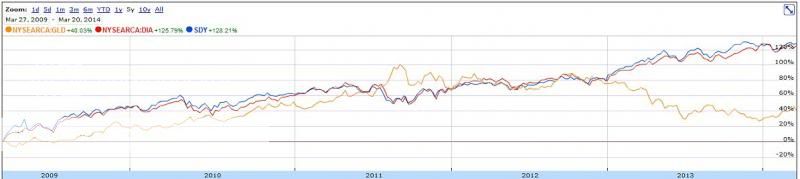
5 year % rise and fall chart for 3 ETFs I own:
SDY *blue line (SPDR S&P Dividend)
DIA *red line (SPDR Dow Jones Industrial Average)
GLD *gold line (SPDR Gold Trust)
index_zps80d00b6a.jpg
 
Back
Top