QLD Roads being destroyed by Mining Industry.

Naphthalene Man said:
willrocks said:
Nugget said:
Anything "free" or where the cost is a one off will get abused.

I'm all for user-pays. Provided it's not user-pays twice, once in taxes, then again when you need it.

A lot of gov services should be "user-pay" rather than "give us all your money and we'll use it wisely".

A lot sure, but not all. Disability and health, public education and public transport should always be subsidised/free.

The problem is we are faced with today is ever-increasing taxes, yet we are asked to pay for services also.

Superannuation is a classic example. It used to be you pay income tax all your life then you go on the pension when you retire. Now you pay (more) income tax your whole life but there's probably no pension because you should have funded it yourself.
 
Nugget said:
http://fueltaxinquiry.treasury.gov.au/content/Submissions/Industry/BIC_234.asp#Summary


Motorists aren't even coming close to paying their own way.


Super Executive summary - multiply what you are currently paying by 1.33 and you'd come close. However if you want to also pay full price then what you're paying right now needs to be multiplied by just shy of 3 times.

Have you ever seen a government report stating they have too much money? Yet taxes continue to increase. They're vultures, there will never be anything left, and they'll always claim there's not enough tax dollars to go around.

It's interesting to see how they value human life:

Table 4.3: Estimated Health Damages from Air Pollution in Australia

10 deaths per year = $810 million

So 1 life = $81 million
 
^^^ WTF?!?

So if each life is worth $81m then (simplistically) each year of life in terms of assessing an infrastructure project is "worth" ~$1 million per year of life.

The average GDP/person is only around $63,000. So the average value of an additional year of life is over 15 times what people can physically produce.

I can't believe they are justifying that we can spend 15 years of our life building random infrastructure assets that increase our life expectancy by 1 year!?! That's not an investment, that's just friggin' stupid.
 
bordsilver said:
I can't believe they are justifying that we can spend 15 years of our life building random infrastructure assets that increase our life expectancy by 1 year!?! That's not an investment, that's just friggin' stupid.

You'll never become a politician with that attitude.

Imagine how thankful that statically insignificant individual would be if they knew their life was in danger, and that years of your toil potentially saved them from a not-so-certain death.
 
none of these freight/public transport/ urban conjestion issues are necessarily a roads problem... you gotta start thinking beyond the roads.

I contend that despite our best efforts, user charging always penalises the poorest and advantages the richest.

And while I may be adding to everyone's congestion costs, everyone else is contributing to mine.
 
bordsilver said:
^^^ WTF?!?

So if each life is worth $81m then (simplistically) each year of life in terms of assessing an infrastructure project is "worth" ~$1 million per year of life.

The average GDP/person is only around $63,000. So the average value of an additional year of life is over 15 times what people can physically produce.

I can't believe they are justifying that we can spend 15 years of our life building random infrastructure assets that increase our life expectancy by 1 year!?! That's not an investment, that's just friggin' stupid.


I'm not a statistician but I suggest that you and willrocks are reading the report wrong. My brother has a PHD in statistics and could no doubt explain it so that I could understand it better however he's in Uganda doing (medical) Doctor things (He's the smart driven one in the family, I get by on my good looks and charm :D )


http://stats.org/stories/2011/value_statistical_life_jun27_11.html

Where VSL numbers come from

Ultimately, such analysis can be used to generate a number in dollars for VSL, using something called the standard wage equation. In their meta-analysis of wage-risk studies, Janusz Mrozek and Laura Taylor give a straightforward explanation of the math behind the numbers. The wage equation is a statistical estimate of the breakdown of wages due to a worker's profile. Variables in the equation account for demographic factors like age and education level, and job characteristics like risk of injury, as well as overall risk of death on the job. VSL is computed as the rate of change of a worker's wage with respect to the change in risk of death.

For example, suppose that the increased risk of death on a job is 1 in 10,000 compared to a job with no observable job-related death, and that a worker is paid an additional $0.35 per hour for accepting this risk. Assume the worker works 2,000 hours per year (40 hours per week times 50 weeks), so that $0.35 x 2,000 = $700 per year in wages is paid to the worker for death risk. Since the expectation is that 10,000 people would be paid this additional $700 per year in wages per one death, the statistical value of life is given by the total marginal wages earned ($700 x 10,000 = $7,000,000) per death.
 
1for1 said:
LOL.. dont worry those trucks and workers will not be required in Australia's NEW economy..

Those Private capitalists are re-allocating resources O.S as we speak.. no jobs, no demand for machinary.. and now no-one to pay taxes to fix that roading.

LOL - what a mess,

this whole mining exodus was entirely predictable.. made worse by a economic slowdown in china.. Ouch + Ouch = Up Schitt creek without a paddle.

1for1

Where are they re-allocating their resources to? China?

Mining is different to Manufacturing in that you cant just pack up and move your operations offshore. You gotta be where the minerals are.

I suppose they could all pack up and go to South Africa for the Platinum?
 
Nugget said:
bordsilver said:
^^^ WTF?!?

So if each life is worth $81m then (simplistically) each year of life in terms of assessing an infrastructure project is "worth" ~$1 million per year of life.

The average GDP/person is only around $63,000. So the average value of an additional year of life is over 15 times what people can physically produce.

I can't believe they are justifying that we can spend 15 years of our life building random infrastructure assets that increase our life expectancy by 1 year!?! That's not an investment, that's just friggin' stupid.


I'm not a statistician but I suggest that you and willrocks are reading the report wrong. My brother has a PHD in statistics and could no doubt explain it so that I could understand it better however he's in Uganda doing (medical) Doctor things (He's the smart driven one in the family, I get by on my good looks and charm :D )


http://stats.org/stories/2011/value_statistical_life_jun27_11.html

Where VSL numbers come from

Ultimately, such analysis can be used to generate a number in dollars for VSL, using something called the standard wage equation. In their meta-analysis of wage-risk studies, Janusz Mrozek and Laura Taylor give a straightforward explanation of the math behind the numbers. The wage equation is a statistical estimate of the breakdown of wages due to a worker's profile. Variables in the equation account for demographic factors like age and education level, and job characteristics like risk of injury, as well as overall risk of death on the job. VSL is computed as the rate of change of a worker's wage with respect to the change in risk of death.

For example, suppose that the increased risk of death on a job is 1 in 10,000 compared to a job with no observable job-related death, and that a worker is paid an additional $0.35 per hour for accepting this risk. Assume the worker works 2,000 hours per year (40 hours per week times 50 weeks), so that $0.35 x 2,000 = $700 per year in wages is paid to the worker for death risk. Since the expectation is that 10,000 people would be paid this additional $700 per year in wages per one death, the statistical value of life is given by the total marginal wages earned ($700 x 10,000 = $7,000,000) per death.


Thanks for the reference. However, $7m per death is a LONG way from $81m per death. At $7m you are getting much much closer to the real output of a particular individual in a given occupation. Further there's a difference between valuing the risk of death of a person doing a specific job versus a generic person. I would argue that any estimate which is substantially away from the average value of output (as this 15:1 seems to be) is flawed if used to justify an investment to reduce the risk of death.

Similarly, any willingness-to-pay measure w.r.t. valuing life must account for the "ability to pay". I might be willing to pay $10m but unless I actually have enough income I can't - so it is simply nonsensical to actually spend up to $10m to save a life (or extend a bunch) unless it results in at least this much extra output.
 
$7 million per death was an example in the link (American) I provided on how the math works and has absolutely nothing to do with the specific figures from the Treasury report, you'll have to muddle through the math yourself as I personally only perform basic math. It's just not my bag


This is the sort of explanation I'd be able to provide.
[youtube]http://www.youtube.com/watch?v=ITUSZ6LRHrk[/youtube]
 
mmm....shiney! said:
Everyone wants their cut don't they?

I love seeing trucks on the roads.
You love seeing trucks on the road, but are you happy to be paying for them? A large truck causes maybe 10,000 times more damage to the road than a car while not paying anywhere near a fair share towards road maintenance. Everyone else bears the cost.
 
SilverPete said:
mmm....shiney! said:
Everyone wants their cut don't they?

I love seeing trucks on the roads.
You love seeing trucks on the road, but are you happy to be paying for them? A large truck causes maybe 10,000 times more damage to the road than a car while not paying anywhere near a fair share towards road maintenance. Everyone else bears the cost.

You know you've just pulled those figures out of thin air. ;)

But you are right, the public funding of roads favours some users at the expense of others. I'd be happy to see the only workable solution implemented - but not many others would.
 
mmm....shiney! said:
SilverPete said:
mmm....shiney! said:
Everyone wants their cut don't they?

I love seeing trucks on the roads.
You love seeing trucks on the road, but are you happy to be paying for them? A large truck causes maybe 10,000 times more damage to the road than a car while not paying anywhere near a fair share towards road maintenance. Everyone else bears the cost.

You know you've just pulled those figures out of thin air. ;)

But you are right, the public funding of roads favours some users at the expense of others. I'd be happy to see the only workable solution implemented - but not many others would.
Actually figures like that are on the low side, especially for the really large trucks. There's plenty of research done on number of axels and road wear.
 
I think you posted something about abolishing vehicle registration fees in favour of a user-pays system recently.
 
mmm....shiney! said:
I think you posted something about abolishing vehicle registration fees in favour of a user-pays system recently.
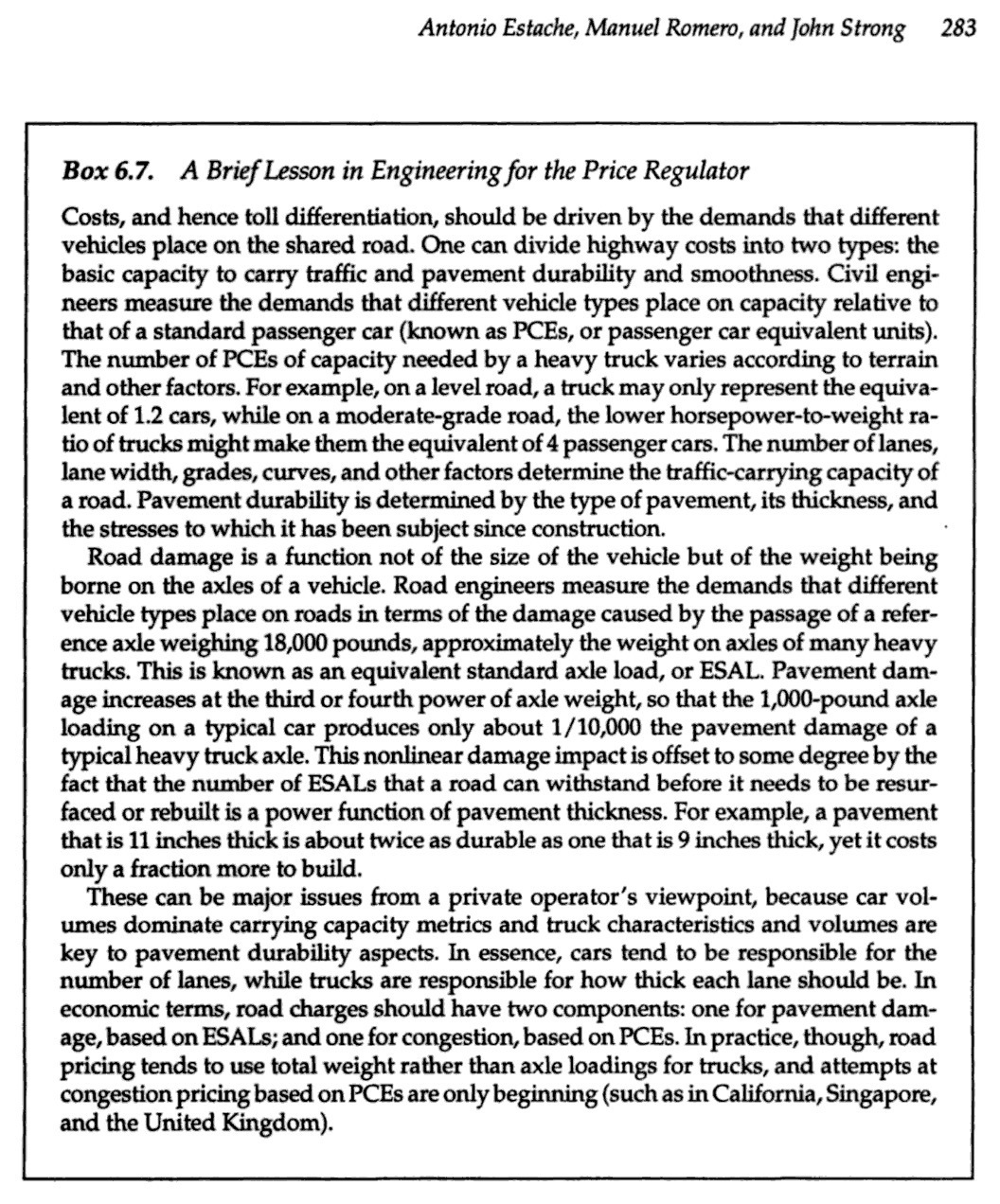
It's a difficult issue to fairly allocate costs. There is a book (probably out of date now) titled Privatization and Regulation of Transport Infrastructure and it has this interesting box on pricing:

0ex3oFF.jpg
 
^ A colleague at work could talk your ear off about this stuff. Bottom line is some form of direct user pays pricing (be it congestion charging/tolls or whatever) will have large benefits.
 
kramer said:
start making the roads from edencrete. problem solved.
At US$6K+ per cubic metre it is a teensy bit more expensive than normal concrete though (<$300/m3).
 
bordsilver said:
kramer said:
start making the roads from edencrete. problem solved.
At US$6K+ per cubic metre it is a teensy bit more expensive than normal concrete though (<$300/m3).

i think it's closer to $480 per cube.

edencrete is an additive added to concrete. it's retail cost is $25 US per gallon. 4 gallons does a cubic yard which is 0.76 cubic metres. you'll need 5.23 gallons to treat a cubic metre of concrete thereabouts so around $130 US which is about $180 aus.
 
Hmm. My converter said 264.1721 gallons per m3 which is where I came up with a different number.
 
Back
Top