Precious metals demand

No doubt there'll be companies teetering on the edge of collapse or actually going over the precipice in the future. The Fed will backstop banks and if a non-bank company goes under it won't mean the end of the world or even another GFC because economic and financial stability in the US is not a thin veneer as argued by @pmbug, in fact it's markedly more solid since the GFC.

A common trait amongst some precious metals investors and especially amongst many online experts is to promote or cling on to any hint of economic upheaval in order to justify their narrative. Goldbugs always cheer on a good disaster. :D

It's mostly misplaced though which can have negative implications when it comes to designing and managing a portfolio.
That last bit I agree with, don't put all of your eggs in one basket. Contrarians have had a bad run, but having said that, gold hasn't been this high (adjusted for inflation), since Silver Thursday or thereabouts. Gold bulls are definitely not eating their proverbial hats.

But just because something is unprecedented, doesn't mean a Black Swan won't happen. US debt is at absolutely unsustainable levels. Commercial RE is one of the many domininoes yet to fall. Why are China and Russia flexing their muscles? It is because the US is hamstrung in debt and division.

You say that they have exported their issues, but I visited the US recently and I can tell you that prices at restaurants are on par with AU, but in USD! Some of those buggers are being eaten alive by inflation. The working poor... those who will never own property, or remain hand to mouth until the inevitable end, like medical bankruptcy, are a thing. USians on here may agree.

Human arrogance is something that will always replay. I've been reading a lot about Titanic lately. The perfect example of human arrogance. Everything is impervious, unsinkable, unfathomable... until it actually happens. Did anyone predict the fall of the USSR? Not a single one. It's hard to comprehend (or predict) the unprecedented.
 
... The failure of those institutions didn't bring down any of the advanced Western economies, therefore they are indicators of robustness as opposed to fragility. ...

We are still living through central bank intervention ripples from Lehman/Bear Sterns almost 20 years out. Enron caused significant dislocations (and interventions) in the financial economy. Every intervention (problem deferred) requires greater and greater responses. If the Fed manages to get it's balance sheet back to the normal growth line level pre-Lehman without the world economy imploding, I'll concede your point, but I seriously do not believe that to be possible. We're not even going to see the Fed QT back to pre-Covid levels. The towering heights you referred to is built upon the lie of fiat money. That lie is unsustainable and really starting to show it's colors. $.02

Some fun (related) reading:
If you want an idea of how the current fiscal and asset bubble in the US might end, pay close attention to Bernard Connolly, esteemed consigliere to hedge funds and central bankers across the world for the last quarter century.

It will not end in a soft landing – a “chimaera” – and will certainly not end in another leg of accelerating economic growth. Nor will it end in soggy stagflation.

The invidious choice facing the Federal Reserve, he warns, is either to allow a deep economic slump to unfold, or slash rates to the bone before inflation has fallen back to target. The latter course will send the dollar into free fall and destabilise the world’s dollarised financial system, an outcome already being sniffed out by the reawakening gold market.
...
“There can be little doubt that there will be a US recession unless the Fed loosens hard and soon. The labour market is weakening and ‘excess savings’ from the pandemic-era handouts are exhausted,” he said.

“The likeliest near-term outcome is that, as in 2000 and 2007, the Fed holds off cutting interest rates just yet, citing worries that inflation is not convincingly and sustainably moving to target. By mid-year the weakening of the economy will have become evident even to the Fed’s modellers. But they will not cut far enough or fast enough,” he said.
...
This points to an initial rate cut in June, followed by cascading cuts in rapid succession, though still too little, too late. The Fed Board is already preparing for a hand-brake U-turn. Governor Adriana Kugler recently reminded everybody that the Fed has a “dual mandate”: jobs as well as inflation.

Days earlier, New York Fed chief John Williams said the supply-side shock of the pandemic had blown over and that US inflation had carved out a near perfect round trip, “like the Apollo missions to the moon and back.” He said three-year inflation expectations are now below their 2014-2019 average. This is a Fed preparing its alibi.

As I wrote last week, the US economy has lost a net 900,000 workers since November, based on the US household survey. This has lifted unemployment from 3.4pc to 3.9pc. The jump is close to triggering the Fed’s ‘Sahm Rule’ recession indicator.

The US economy is not as strong as widely assumed. The latest US financial accounts show that gross domestic income (GDI) grew by just 1.2pc last year. This measure has been consistently weaker over recent quarters than the GDP figure, which ought to give pause for thought.

A Fed study found that GDI is more accurate when the economy rolls over. It foretold a recession in 2007 at a time when the GDP figures (revised down later) were still signalling clear blue sky.
...
The Wicksellian theme running through Mr Connolly’s book is that central banks have created a chronic ‘intertemporal’ misalignment in the western economies, starting with Alan Greenspan in the 1990s.

They have let asset booms run unchecked but have always stepped in to prevent the economy coming back into balance during downturns. But you cannot pull consumption from the future forever without consequences. The future catches up with you.

“The real difficulty with the Greenspan maxim – that a problem deferred is a problem solved – is that you have to keep on deferring, via ever-bigger bubbles that ultimately threaten to destroy both capitalism and democracy,” he said. Furthermore, this reflex obstructs the Schumpeterian cleansing process of creative destruction.

As Joe Biden’s budget boom deflates this year it will become clear that the US economy cannot handle interest rates anywhere near the current level of 5.33pc. America and the West will discover that they are on the same conveyor-belt towards “ever-lower real interest rates”, requiring drastic cuts to refloat the next bubble in equities and credit.

My angle is slightly different. Deflation will keep coming back to haunt us with each cycle – requiring zero rates and crazy money – because of ageing demographics, digital technology, and above all the Asian saving glut.

The cardinal fact is that China produces 31pc of global manufactured goods but accounts for 13pc of total consumption. Xi Jinping’s regime is dumping massive excess capacity on the rest of us. It is reverting to the worst practices of Leninist capitalism. This is the elephant in the global rowing boat.

Whether Mr Connolly is right or savings glut theorists are right, both imply a secular collapse in the natural rate of interest and the subversion of western free market system.

The central banks and the academic priesthood are floundering because their canonical DSGE model – new neoclassical synthesis – assumes that the economy comes back into equilibrium when it patently does no such thing. The model is self-evidently defective but all other voices – Wicksellian, monetarist, Austrian, or old Keynesian – have been shut out of the debate.

The priests were badly wrong in 2007-2008. We will find out who is badly wrong this year soon enough.

https://www.telegraph.co.uk/busines...-face-horrible-choice-warns-bernard-connolly/

...
The “lowest possible level” of the Fed’s balance sheet in 2026?

No one knows, not even Fed, but here is our guess: $5.8 trillion, limited by the liabilities.
...
Realistically speaking, getting the balance sheet close to $6 trillion by the end of 2026, so shedding another $1.5 trillion, after the $1.45 trillion that have already been shed, will be a big improvement, meaning that the Fed’s balance sheet will by then have shed about $3 trillion, assuming that nothing blows up along the way.

https://wolfstreet.com/2024/03/23/t...f-the-balance-sheet-without-blowing-stuff-up/

...
The banking system is not crying about Basel III requirements. ...

You and I must read different financial media.
 
Thanks for chiming in here @pmbug

Overall, I am glad to throw out some ideas and banter. It is something that SS hasn't had in a while. I hope everyone is doing well.

Whatever I say, (FYI) don't get offended as I often throw around unpopular or contrarian opinions. But I guess that that is something in the West we can still celebrate. Increasingly, the unelected status quo really do control the official (and unofficial) narrative.
 
Thanks for chiming in here @pmbug

Overall, I am glad to throw out some ideas and banter. It is something that SS hasn't had in a while. I hope everyone is doing well.

Whatever I say, (FYI) don't get offended as I often throw around unpopular or contrarian opinions. But I guess that that is something in the West we can still celebrate. Increasingly, the unelected status quo really do control the official (and unofficial) narrative.
Your Contrarian ideas are most welcome on SS. Your polite input is very interesting as are the other posters here who also don’t name call or abuse. It makes for an interesting discussion.
I have learnt a lot from this thread,
 
But just because something is unprecedented, doesn't mean a Black Swan won't happen. US debt is at absolutely unsustainable levels. Commercial RE is one of the many domininoes yet to fall. Why are China and Russia flexing their muscles? It is because the US is hamstrung in debt and division.

Black Swans by their nature are completely unpredictable. If we've had any we've survived them though. We could be wiped out if Taupo explodes as well - but that doesn't mean it's likely to happen.

As far as US debt being unsustainable, I'm still yet to hear a cogent argument as to why that is the case.

Commercial RE is a problem according to many I listen to, we'll see what happens there. If anything. And as far as Russia and China go, my novice view is that they're flexing their muscles to solidify their domestic power base. If there are weaknesses in the US and allied foreign policy arenas it's complicated but without wanting to go into that discussion it's just that the West has neglected establishing and/or maintaining strong ties with other nations. Whether that's in economic aid, defence or trade and you can add nationalist introspection which is making it worse.

Did anyone predict the fall of the USSR? Not a single one. It's hard to comprehend (or predict) the unprecedented.

The frailty of communism was its own downfall. I wouldn't be using a non-democratic nation that relied on a system of government that utilised murder, owned the means of production, was completely opaque on matters of governance and adopted a system of law that offered no protection of property rights in any analogy that attempts to draw parallels with modern advanced Western economies.

Adam Smith understood how a nation succeeds around 250 years, and the UK still remains one of the most prosperous nations in the world as are most free-market economies.
 
Last edited:
We are still living through central bank intervention ripples from Lehman/Bear Sterns almost 20 years out.

Like what?

The Fed has a mandate to ensure financial stability. Wherever humans gather to trade for profit there are going to be individuals breaking or bending rules to gain an advantage. These can have negative and sometimes unforeseen results which require central planners to intervene, often having to play catch-up with legislation and policy decisions after the horse has bolted. What definitely hasn't helped is politicians largely shirking their fiscal policy responses and basically leaving it up to central banks to manage the economy. Fiscal policy responses have been the exception instead of the norm as they were in the past.

Every intervention (problem deferred) requires greater and greater responses.

If measured in $ then of course that is going to be the case purely because of monetary inflation. But if measured in broad scale systemic incidents then that is not true. The response to the GFC was broader and of a systemic nature compared to the collapse of SVB et al and The Fed's response to what was essentially a contained crisis limited to regional banks and dodgy crypto entrepreneurs.

We're not even going to see the Fed QT back to pre-Covid levels.

I don't know why you'd expect any different. After all there will be a point in the future where the effectiveness of The Fed's decision to stop rolling over assets as they mature in order to reduce the balance sheet will cease. Further, as one of the authors in an article you linked stated, no one knows what is an acceptable level to hold on the balance sheet. And you can add the neutral rate to the list of life's financial mysteries as well as how much should be held on behalf of banks as reserves. That stuff just evolves as shit happens.

The towering heights you referred to is built upon the lie of fiat money. That lie is unsustainable and really starting to show it's colors. $.02

You and I must read different financial media.

I have no issue with a fiat system in modern economies where governments have a monopoly on the issuance of currency. The governments of modern advanced economies cannot function in any other way. That means you and I are not even starting from common ground. ;)
 
Like what?

Lehman/BS -> TARP -> QE -> ZIRP -> today's mess

BTW, WRT Basel III:
The Federal Reserve's top regulator said he's collaborating with other board members to come up with fixes for their proposed capital reform package.

During a Friday afternoon speaking engagement at the University of Michigan, Fed Vice Chair for Supervision Michael Barr discussed the so-called Basel III endgame, which he said had sparked "lots of controversy" in the banking sector.
...

https://www.americanbanker.com/news/feds-barr-working-with-powell-to-find-consensus-on-basel-iii
 
Lehman/BS -> TARP -> QE -> ZIRP -> today's mess

As I stated above, The Fed's function is to maintain financial stability, the recent policy decisions they make are not hangovers of the GFC but rather responses to crisis as they emerge.

Your timeline should go back to when the Federal Reserve was established, and probably even include all of the financial crisis that led to the establishment of both the First and Second Banks of the US way back in the 1790s. If it did the argument that current intervention is a hangover from the GFC would be seen in the light of the history of monetary policy since the American Revolutionary War and found to be wanting. If there is a hangover from the GFC, and I believe there is, I would argue it largely stems from the lack of fiscal policy response from from politicians as opposed to the intervention (or more particularly absence of intervention) from The Fed at the time.

Your Basel III link is behind a paywall. Looks like those smaller banks (above $100B in assets) have put on enough political pressure to cause some friction. A bank with $100B in assets is not considered large, despite what the authors of the article maintain.
 
Last edited:
The banks will get endless bailouts anyway and a total collapse is not an issue for them. The Fed can and will buy it all. Powell is the man with the credit card and the gold stackers hero this time.

Even if everyone loses everything they can still claim a soft landing, as long as their system survives which always does.
 
... The banking system is not crying about Basel III requirements. ...

More "not crying":
The Basel III endgame proposal threatens to create an uneven playing field for the U.S. operations of international banks which, left unchanged, could result in less investment, less liquid markets and less competition in the U.S. financial system.

In the United States, internationally headquartered financial institutions hold more than $4 trillion in assets, directly employ approximately 200,000 people and represent a majority of the primary dealers in the U.S. Treasury market. According to the most recent data available from the Federal Reserve Board, they also made $661 billion in commercial and industrial loans in the United States in the first nine months of 2023 alone. Further, these institutions are often the primary facilitator of investment in the United States by international companies, which has helped transform many states in the U.S., particularly in the Southeast.

The contributions of international banks to the U.S. economy, however, could be significantly impacted if changes are not made to the proposed U.S. Basel III endgame rule.
...

https://www.americanbanker.com/opin...y-disadvantage-international-banks-in-the-u-s

Note that this "not crying" isn't coming from the small or regional banks - it's being driven by the G-SIBs.
 
I remember reading a very old article talking about when the FED was being established. The article talked about all the negative press being written by the big banks apposing the implementation of a central bank and how it was done as reverse psychology. The big banks in reality wanted the formation of the FED and understood if they made it seem like they didn't want it, it was more likely to get government and public acceptance. The formation of a central banks gave the bigger banks (inside club) an uneven playing field from the smaller banks and ensured their dominance.
 
Last edited:
The frailty of communism was its own downfall. I wouldn't be using a non-democratic nation that relied on a system of government that utilised murder, owned the means of production, was completely opaque on matters of governance and adopted a system of law that offered no protection of property rights in any analogy that attempts to draw parallels with modern advanced Western economies.

Adam Smith understood how a nation succeeds around 250 years, and the UK still remains one of the most prosperous nations in the world as are most free-market economies.
UK is cooked, their massive drop in living standards are constantly in the news. The almost had a "Black Swan" with Liz Truss' budget.

Granted, the USSR is not a great example, mainly due to its centrally-planned command economy. My point is that systems and nations collapse, even advanced capitalist ones. Germany's Weimar Republic was an advanced economy. Even Blind Freddy can tell you that the USA (and arguably the UK/AU) have been on a bumpy, yet steady downward trajectory since September 11, 2001. Sure, it is bad to pick a specific date, but it sticks out; how much has the world changed since then! Or maybe the March 2003 invasion of Iraq. WE ARE NOT IMMUNE TO HISTORY. To think that economic collapse, war, thuggery, religious fundamentalism, homophobia, savage nationalism, hyperinflation are things of the past are delusional. Politics and economics are intertwined, and it's pretty much 1939 right now; gold prices are reflecting this. The question is not if but when something horrible is going to happen. I believe most people, deep down, don't feel too good about the direction of the world.

Regarding the USSR, sure it was, well, pretty close to what Russia is today with what you say: "a system of government that utilised murder, owned the means of production, was completely opaque on matters of governance and adopted a system of law that offered no protection of property rights". ;) If you are not connected over there, you are nobody. There are millions in that nation that never really made it out of Tsarist peasant-style poverty. Western Russian fanboys have never been outside of any major city in the nation, and most have never actually set foot in the country.
 
Last edited:
WE ARE NOT IMMUNE TO HISTORY. To think that economic collapse, war, thuggery, religious fundamentalism, homophobia, savage nationalism, hyperinflation are things of the past are delusional.

I'm not being delusional, merely advancing the line that capitalist nations with a long history of property rights enshrined in law are more secure and therefore able to withstand shocks to a greater extent than those nations that aren't.

The Weimar Republic collpased because it was war ravaged. That can happen to any country, democratic or undemocratic.

The foundations underlying the modern financial systems in advanced economies are more sturdy now than at any time in history, so as a result our capacity to avoid any collapse is more robust than previously and especially when compared to non-Western nations. Some may consider that to be a "glass half full" view, on the contrary I consider it based on a sound understanding of how modern economies function and the role that regulators have in ensuring that they achieve their mandate given that there can never be a guarantee that shit won't hit the fan. It's just that we're in a better position now than in the past to deal with it generally.

I believe most people, deep down, don't feel too good about the direction of the world.

I don't know most people, but I do know that pessimism is an evolutionary trait and that being an optimist requires doing a lot of homework, as does anything concerned with an individual's mental state. Just ask any golfer.

PS: I'm in a nice mental place on the golf course at the moment. ;)
 
I'm not being delusional, merely advancing the line that capitalist nations with a long history of property rights enshrined in law are more secure and therefore able to withstand shocks to a greater extent than those nations that aren't.

The Weimar Republic collpased because it was war ravaged. That can happen to any country, democratic or undemocratic.

The foundations underlying the modern financial systems in advanced economies are more sturdy now than at any time in history, so as a result our capacity to avoid any collapse is more robust than previously and especially when compared to non-Western nations. Some may consider that to be a "glass half full" view, on the contrary I consider it based on a sound understanding of how modern economies function and the role that regulators have in ensuring that they achieve their mandate given that there can never be a guarantee that shit won't hit the fan. It's just that we're in a better position now than in the past to deal with it generally.


I don't know most people, but I do know that pessimism is an evolutionary trait and that being an optimist requires doing a lot of homework, as does anything concerned with an individual's mental state. Just ask any golfer.

PS: I'm in a nice mental place on the golf course at the moment. ;)
It's good to have a positive Yin to my pessimist Yang.

The Weimar republic didn't collapse due to being war-ravaged (most of Europe was after the war), it was due to massive debt due to war reparations and monetary debasement.

Regarding the US, I always think of Michael Douglas' character in Wall Street. A very misunderstood speech, mainly because not many people know much about it:

"Well, ladies and gentlemen, we're not here to indulge in fantasy, but in political and economic reality. America, America has become a second-rate power. Its trade deficit and its fiscal deficit are at nightmare proportions. Now, in the days of the free market, when our country was a top industrial power, there was accountability to the stockholder. The Carnegies, the Mellons, the men that built this great industrial empire, made sure of it because it was their money at stake. Today, management has no stake in the company!

All together, these men sitting up here [Teldar management] own less than 3 percent of the company. And where does Mr. Cromwell put his million-dollar salary? Not in Teldar stock; he owns less than 1 percent. Teldar Paper, Mr. Cromwell, Teldar Paper has 33 different vice presidents, each earning over 200 thousand dollars a year. Now, I have spent the last two months analyzing what all these guys do, and I still can't figure it out. One thing I do know is that our paper company lost 110 million dollars last year, and I'll bet that half of that was spent in all the paperwork going back and forth between all these vice presidents. The new law of evolution in corporate America seems to be survival of the unfittest. Well, in my book you either do it right or you get eliminated.

I am not a destroyer of companies. I am a liberator of them! In the last seven deals that I've been involved with, there were 2.5 million stockholders who have made a pretax profit of 12 billion dollars. (Gecko was a corporate raider)
The point is, ladies and gentleman, that greed -- for lack of a better word -- is good.
Greed is right.
Greed works.
Greed clarifies, cuts through, and captures the essence of the evolutionary spirit.
Greed, in all of its forms -- greed for life, for money, for love, knowledge -- has marked the upward surge of mankind.
And greed -- you mark my words -- will not only save Teldar Paper, but that other malfunctioning corporation called the USA."

The film seems dated as Gordon Gecko would turn over in the proverbial grave if he saw the "debt, deficit, disaster" of 2024 (the film was 1987). It really is survival of the unfittest with inefficient corporations, the woke, the autistic, as well as the LGBTI+ supporters thriving. All parasites. Gecko He would've broken up zombies like Qantas, and inefficient duopolies like Coles and Woolworths. Not saying that he was a nice guy, but he represented unbridled laissez faire economics.

In these times, double digit interest rates would cause a Soviet Union style collapse, mark my words. Any US politician would go back to that balance sheet in a nanosecond. I read that there is a big furore about fast food employees in the USA getting 20 dollars an hour, this is 30.79 AUD. Even our minimum wage is lower here, but it goes to show the monetary debasement that has gone on; USD is worth a lot in AU, but it doesn't go too far in the actual USA; like I said, I recently visited there.

And when I mean debt, it is private debt that is IMO the biggest drain on economies, not just gov't debt. It just grows and grows and grows. Imagine where all that money could be going in this country instead off paying off massive interest rate bills?
 
Last edited:
Ok, my "war ravaged" comment was a bit offhand, basically destroy a nation's productive capacity and then print money as the solution and then you get fkd. My point was that Oz, the US etc still has the productive capacity to meet the needs of its citizens. Germany didn't.

I thought the most interesting point you made was this:

And when I mean debt, it is private debt that is IMO the biggest drain on economies, not just gov't debt. It just grows and grows and grows. Imagine where all that money could be going in this country instead off paying off massive interest rate bills?

Putting aside the debate around private debt v GDP or whatever other metric is used to decide whether it is sustainable or not - if the debt didn't exist in the first place then there would be less money circulating in the system anyway. So paying off increasing levels of debt doesn't divert funds from more useful purposes, which sounds similar to the Austrian's fallacious "crowding out" concept. Essentially, the funds don't exist without debt (ie spending) being created in the first place.
 
The foundations underlying the modern financial systems in advanced economies are more sturdy now than at any time in history, so as a result our capacity to avoid any collapse is more robust than previously and especially when compared to non-Western nations

I don't understand the sturdiness you see unless you mean our ability for endless Fed bailouts?
That's not sturdiness by traditional standards.
 
I don't understand the sturdiness you see unless you mean our ability for endless Fed bailouts?

The compliance requirements as set out by legislation, deposit insurance schemes and if we're talking US banks, the capacity for the regulators to provide liquidity in one form or another to prevent bank collapses or at the very least, to prevent them from becoming systemic.

That's not sturdiness by traditional standards.

What traditional standards do you mean? I would argue that none existed.
 
So you mean yes. Endless bank bailouts are sturdy haha. I'd agree.

Bailouts are justified, even if they create a moral hazard.

This means the modern financial system is far sturdier than ever existed under your "traditional" standards - or should I say "absence of any standards".

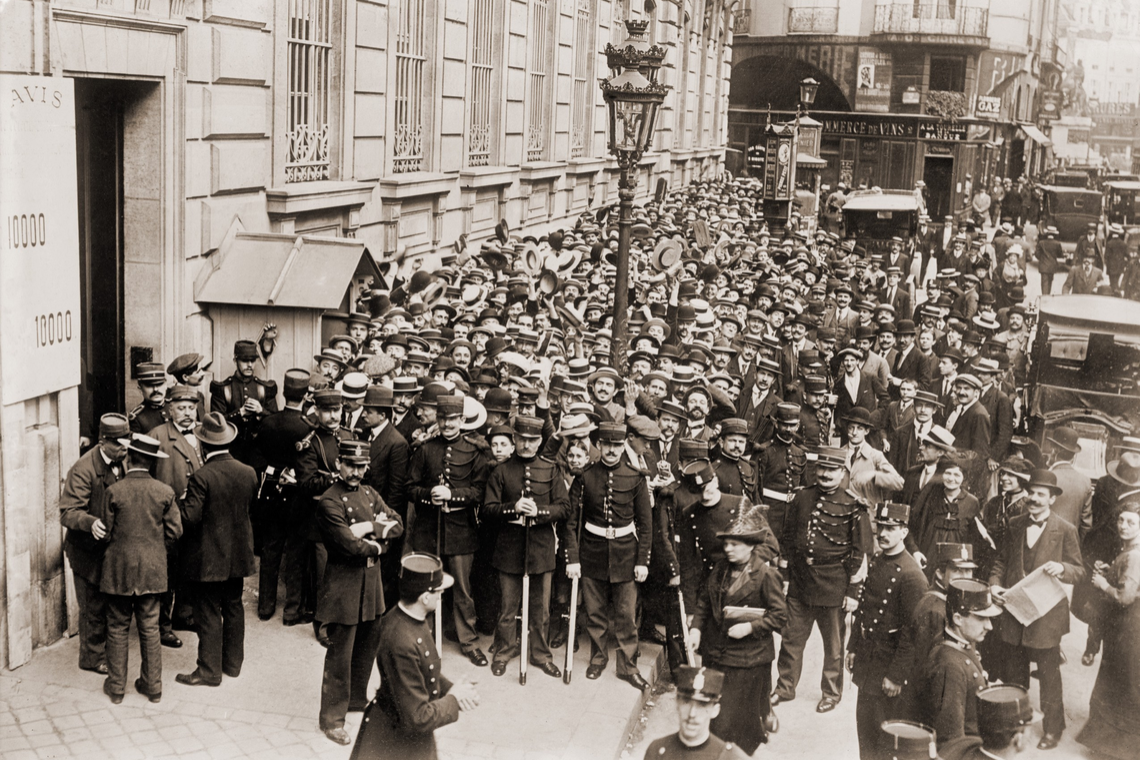
Edit to add: but if it's the old days you're yearning for, then here's a shot of a good old traditional bank run. Complete with sturdy cops with sturdier batons. ;)

shutterstock_242294071.png
 
Last edited:
Back
Top