Historical purchasing power of a Sovereign

JulieW

Well-Known Member
Silver Stacker
The Sovereign was made from gold of varying weight and purity over the years, until the Great Recoinage Law of 1816 when the gold content was fixed to 7.322 grams, at which it currently remains.

A Sovereign coin represented One Pound or 20 Shillings or 240 Pennies in the old currency.

Read more: http://wiki.answers.com/Q/What_is_a_British_Sovereign_coin#ixzz1nNJBlGn6

So what would a pound buy in 1816

He held up a one pound coin. "This piece of brass," he said in a voice eerily reminiscent of Marlon Brando's Don Corleone, "is one of your pounds. The famous pound. The backbone of your great empire."

Then, in his other hand he held up another coin, a gold sovereign. "A hundred years ago this was your pound 7.32 grammes of pure gold."

Gesturing with the brass, he said: "It took me 235 of these," - he motioned with the sovereign - "to buy one of these".

In other words, the purchasing power of the pound has fallen by 235 times in a hundred years.
11-02-02-MM01.ashx

Source:

That's the fiat currency story. But in real terms,:
http://www.victorianweb.org/economics/wages2.html

Cost of Living for a typical, rising professional man with a 700 annual income (early 1900s)

Rent and Taxes 100
Two maids 42
Food & Cleaning materials For 4 people 104
Washing 26
Coal 1 ton/month 12
Electric Light 18
Wine 10
Office expenses
Trainfair and lunches 30
Insurance 25
Dress x2 80
Savings 50
TOTAL 487
Source: Bowley

700 sovereigns would be about $280,000 per year today at gold value

Quite wealthy

Cost of Living for a senior Clerk 1844
(pounds/shillings/pence)
Rent 25/0/0
Taxes 5/0/0
Maid 7/0/0
Coal 5 tons 6/5/0
Candles and Wood 2/0/0
Tea 7/16/6
Sugar 6/14/2
Butter & Eggs 9/12/0
Meat 18/6/0
Fish 2/0/0
Vegetables 5/0/0
Beer 6/10/0
Washing woman soap and her meals 6/13/0
Ironing and mangling 1/0/0
Clothing 23/6/0
Church and charity 3/10/0
Doctor 5/0/0
Misc. 1/8/0
Amusements 1/19/4
Savings 6/0/0
Total 150/0/0

150 sovereigns would be about $60,00o per year.

Making a definitive statement about the cost of living in Victorian England is difficult, particularly in the last half of the century, because the economy went through a long period of growth, followed by slumps at the end of the nineteenth century. A worker in 1870 might make 150% what a worker in 1850 made, but because different prices had increased at different rates, the actual buying power of the wages increased only moderately. At the end of the century, prices fell greatly, more rapidly than wages, so that despite a lower wage, the workers buying power actually increased.

Wages generally:
Wages

1. According to Porter (176), in the mid-1860s workers in London received the following wages for a 10-hour day and six-day week:

common laborers 3s. 9d.
excavators wearing their own "long water boots" 4s. 6d.
bricklayers, carpenters, masons, smiths 6s. 6d.
engineers 7/6 (= 110 pounds/year)
2. These wages reflect weekly pay in the mid- to late '60s (various sources listed below)

Mail Coach Guard ... 10/0 + tips
Female telegraph clerk ... 8/0
London artisans ... 36/0
London laborers ... 20/0
Farm hands ... 14/0
Sailors ... 15/0
Seaman on steamers ... 16/4
3. In better paid positions, particularly the professions, salaries were indicated in annual amounts. Two positions for which information is available are:

Army Cornet ... 200/0/0
Indian Civil Service officer ... 300/0/0

12 pence to a shilling, 20 shillings to a sovereign

Anyone like to comment or discuss?
 
Brilliant J - Thankyou - Also reaffirms the purchasing power of USD$1 in 1916 is now equivalent (2011) to USD$0.06 (US 6c) x
 
"At the time when Sir Thomas Brock's Veiled Head design was introduced, the nation was in the firm grip of economic depression. Much of the foreign capital that had been invested in the great Australian land boom was being repatriated, and this outward flow of capital was driving many respected banks to collapse. Although by 1893 the volume of banking failures was easing from a rush to a trickle, the economic hardship that the depression caused the average Australian during the last years of the Victorian era was compounded by the beginning of a drought that affected the entire nation. Needless to say, a sovereign during this period had a high value indeed, accounting for at least half a week's wages for the average man. The economic hardship that the nation endured during this time is reflected to a degree by the reduced mintage of the 1893 Sydney & Melbourne Veiled Head sovereigns."

It was two sovereign a week around the turn of the 19 centaury in Australia, or close to $800 gold value today with no income tax.
 
Average full-time earnings in Australia were $64641 per annum in 2010
So average disposable wage today is still 104 sovs per annum or thereabouts?
So based on a 20 year retirement plan at average wage, one should consider stacking around 2,000 sovs across one's working life. say 40 years, or about 500 oz of gold.
Meaning 50 bullion sovs per year, or 1 per week.
I wish I'd realised that when I was 18.
Or worked out a full dates and types collection would do about the same.

Frankly, rather depressing.
 
Nothing real really changes does it? Only the amount of paper money to get it!

One oz of silver a day to run a family, monthly grocery tokens of 1/10th oz gold and getting to the church on time cost you half a sovereign for a cabbie to break all the rules (The Adventures of Sherlock Holmes by Doyle, "A Scandal in Bohemia" :)

Who says fiction can't reflect reality?

We have lots of "things" to spend our money on but the important things, food, light, water, clothing stay the same (except for their rising paper money cost).

Thanks for this thread JulieW - fasacinating and a lot of work on your part.
 
JulieW said:
So based on a 20 year retirement plan at average wage, one should consider stacking around 2,000 sovs across one's working life. say 40 years, or about 500 oz of gold.

...

Frankly, rather depressing.

Yep. Who here has 500oz of gold in super :(

I've heard a figure before - save an ounce of gold for every month you plan to spend in retirement. About half of what you've quoted, but still a significant number.
 
An interesting point to note is the rate of taxes in those first few examples - worked out as percentages they are ridiculously cheap compared to now.

An absolutely fantastic article - nice work Julie!
 
Bullion Baron has done some work on this which is excellent. (with thanks BB)

http://www.bullionbaron.com/2011/07/wagegold-ounce-ratio-australia.html
Average%2BWage%2BGold%2BOunces.png

Source:

I came to the idea of sovereigns because a sovereign a week could take care of a single retirees basic expenses (assume no rent, no extravagances but food, bills, rates, petrol, a cinema trip or two, a few meals out etc) and 2-3 sovs per month above that would add the "joie de vivre" - trips, indulgences etc that retirement is supposed to hold. (modest lifestyle but comfortable)- hence the search for sov/wages relativity.

But now looking at Bullion Baron's work I wonder if saving bullion sovereigns is truly the answer, or whether sets or single examples with numismatic value would be a safer way to 'save' for retirement, considering the variables associated with stacking bullion (including bullion sovs)

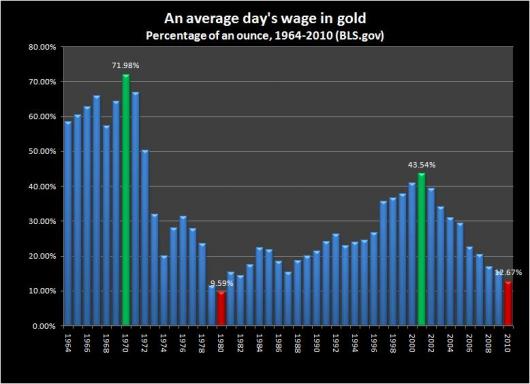
This data is from USA but the points are universal:
averagewage%20-%20gold_0.jpg

Source:

As measured by gold, the value of a day's wage reached its zenith in 1970, when those wages measured in dollars were a lowly $28! Although a day's wage more than doubled to $57 by 1980, their value, measured by gold, fell by 87 percent to just 13 percent of 1970s magnitude.
From this low point in 1980, wages again double to $118, while the value of those wages jump 4.5 times their 1980 lows. However, this gain only brings them to about 61 percent of the value they had in 1970. This gain also marks the top of the business cycle as the value of a day's wage again turns lower in our current depression falling to the present level.
In 1970, a day's wages could buy nearly three quarters of an ounce of gold; by 2010 those wages could only buy a little more than one eighth of an ounce of the metal. Your wages have quintupled since 1970, yet you actually have become poorer. If you are making the average hourly wage of $19 per hour, you are experiencing a level of poverty that was unimaginable to your grandfather, who made only $3.50 an hour in 1970.

Bolding is mine - so in effect the potential resale of your bullion could NOT be a good retirement plan. If you retired and sold gold to live in 1970 you'd have to sell a lot of your stack to pay for dinner. In 1980 you'd be dining out on a fraction of the gold you sold in 1970. So if you retire in the wrong decade, all that stacking could be to nought.

and more on the issue of variables:
*****
The value of a day's wage and the value of an ounce of gold how much of one can be exchanged for the other, their exchange ratio is, of course, subject to fluctuations arising from supply and demand, the business cycle, and improvement in the productivity of work.
If there is a shortage of labor power, we can expect it to trade above its value; if there is a surfeit of labor power it will trade below its value. During periods of economic expansion, we would expect it to trade at the upper end of these fluctuations; and contractions would lead it to trade toward the lower end of those fluctuations. Improvement in the productivity of gold producers might either outstrip or lag that of a typical basket of goods which compose a working class household budget.

From a coin seller:
Rare coins have significantly outpaced gold in the past 30 years, particularly during rising inflation. However, rare coins have not done nearly as well as gold in the past 10 years. Why? Simply because rare coins are driven by inflation and prosperity, two conditions that are in very short supply during disinflationary recessions like today's.
http://www.blanchardonline.com/beru/rarecoins.php

So, in contrast to Mike Maloney's viewpoint, perhaps if this is 'the great deflationary depression' unfolding worldwide, some numismatic value to your "retirement" sovs may be a safer hedge than pure bullion, especially since you have a floor to your savings being the gold price and numismatic premium will/should increase over time, whereas bullion value may not (see the 15 years of gold stagnation prior to 2000)

Or am I on the wrong track here?
 
Or better to build a stack and swap it for income producing assets prior to retirement?

Unless its different this time and there won't be cycles in future.
 
goldpelican said:
JulieW said:
So based on a 20 year retirement plan at average wage, one should consider stacking around 2,000 sovs across one's working life. say 40 years, or about 500 oz of gold.

...

Frankly, rather depressing.

Yep. Who here has 500oz of gold in super :(

I've heard a figure before - save an ounce of gold for every month you plan to spend in retirement. About half of what you've quoted, but still a significant number.


I wish I had 500 oz squirreled away right now. :( Some who start stacking in the 1990's just might but are not likely to talk about it.

My goal is to be able to sell one ounce of gold and 20 ounces of silver per month over an assumed 20 years of retirement. That plus pension and other savings should be sufficient. In the working years I have left I have a decent chance of pulling that off. :)
 
Trouble with these sorts of retirement plans is that it assumes purchasing power of metal will remain a constant - whereas most people right now are stacking in anticipation of purchasing power increasing! Bit of a cake and eat it scenario. We would be in trouble if gold's purchasing power should decline in future.

I definitely plan to have gold at time of retirement - but for me that's 20-30 years away - so I'm sure hoping that there's been opportunities to swap gold for "other useful stuff" before then that will find retirement.
 
goldpelican said:
Or better to build a stack and swap it for income producing assets prior to retirement?

Unless its different this time and there won't be cycles in future.

This is the SMART MONEY statement.

This way - you can have your cake and eat it too!!

malachii
 
As measured by gold, the value of a day's wage reached its zenith in 1970, when those wages measured in dollars were a lowly $28! Although a day's wage more than doubled to $57 by 1980, their value, measured by gold, fell by 87 percent to just 13 percent of 1970s magnitude.
From this low point in 1980, wages again double to $118, while the value of those wages jump 4.5 times their 1980 lows. However, this gain only brings them to about 61 percent of the value they had in 1970. This gain also marks the top of the business cycle as the value of a day's wage again turns lower in our current depression falling to the present level.
In 1970, a day's wages could buy nearly three quarters of an ounce of gold; by 2010 those wages could only buy a little more than one eighth of an ounce of the metal. Your wages have quintupled since 1970, yet you actually have become poorer. If you are making the average hourly wage of $19 per hour, you are experiencing a level of poverty that was unimaginable to your grandfather, who made only $3.50 an hour in 1970.


Hi Julie
These figures are really suss!
I started work in 1970 and adult wages then was closer to $1.20 an hour. Another thing that is overlooked is we had a much longer working week than people nowadays.
If you worked in a bank or office you might be lucky and only have to work Monday to Friday. Blue collar workers and retail staff had to put in a 44 hour week (5 1/2days)
I left school a few months after I turned 16 and got a job in a menswear store.
I was expected to work five and half days a week for the princely sum of $21.70 (less than 50 cents an hour)
My father who was the manager of a travel agency was paid approx $50 a week also for a five and a half day week. He was also expected to be on call 24/7 if there was any problems outside business hours as a car rental agency was linked to the business.
Fifty cents was a princely sum in those days. When I was working in Brisbane in 1971 and lived on my own, lunch at the Coles cafetaria was where I got my main meal for the day.
The 50 cent lunch special consisted of a salad, main meal, bread/butter, dessert and a pot of tea or coffee.
I also moved from a more expensive boarding house ($7 a week) to one that cost me ($6.50 a week) just to make ends meet.
The 1950s, 1960s, 1970s and 1980s were not halycon times for baby boomers as imagined by revisionists who were born much later.
 
There has been stories in the news lately from finding massive silver hauls at the bottom of the ocean to massive misreporting of the actual world gold reserves. If indeed there is a significant adjustment to the amount of physical precious metals available, what effect will that have on their purchasing power. No matter how much physical anyone has, there is still counter party risk because the metals spot price is out of our hands.
 
I thought the 40 hour week came a lot early than 1970? In the late 70's they were pushing for the 38 hour week I seem to recall.
 
Silverthorn said:
I thought the 40 hour week came a lot early than 1970? In the late 70's they were pushing for the 38 hour week I seem to recall.
I think 40 hour week was for white collar.
Retail and blue collar was working longer hours when I left school.
 
Aurora et luna said:
Silverthorn said:
I thought the 40 hour week came a lot early than 1970? In the late 70's they were pushing for the 38 hour week I seem to recall.
I think 40 hour week was for white collar.
Retail and blue collar was working longer hours when I left school.

Well I know when I started working as a qualified tradesman in the early eighties we started getting rostered days off at some stage so we got the 38 hour week somewhere around then. I don't think we had it when I was an apprentice but there was a lot of industrial disputes going on when I was.
 
Though I collect Perth UNC Sovs and the odd numismatic gold coin.........., My rough retirement plan is about 2 $200 Koala gold coins each month until I retire ,15-20 years or so but of course theres super etc, I just like the back up of gold and these coins are at minimum always worth $200........
 
Back
Top