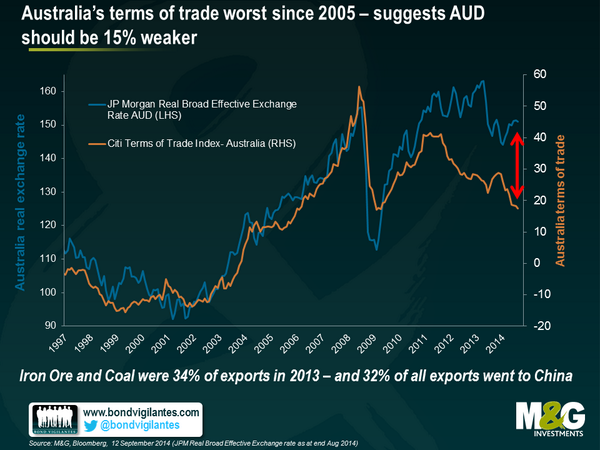
Aussie dollar to drop below 66c - "benign" collapse ahead

@SilverPete, I couldn't quote you for some reason :/

The comment was specific to new mining investment, not short term exports. New investment is declining, and this is something the RBA takes into account when setting rates.

I think in the main it's because the huge amount of mining equipment required for future expansion has been purchased already.
 
Some more charts I found interesting - 1995 vs 2010:

Countries Australia exports to in 1995 (top) and 2010 (bottom)
tree_map_export_aus_show_all_1995.png


tree_map_export_aus_show_all_2010.png


Australian Exports in 1995 (top) and 2010 (bottom)
tree_map_export_aus_all_show_1995.png


tree_map_export_aus_all_show_2010.png


Australian Imports in 1995 (top) and 2010 (bottom)
tree_map_import_aus_all_show_1995.png


tree_map_import_aus_all_show_2010.png


Source: http://ckrao.wordpress.com/2012/06/26/exports-and-imports-by-country/
 
SilverPete said:
^^^ good charts ^^^

Shows our heavy reliance on very low value-add exports at the expense of all other sectors. I notice in 2012 that at least vehicle exports stood out a little, something which we have now decided to kill which reduces again the few opportunities available in this nation to gain and to profit from engineering and high tech skills.

It's slow motion economic suicide.
The old notions of a linear value adding chain are becoming more and more meaningless as the complexity of the capital chain has increased overtime and B2B transactions between different "industries" become more and more incestuous. I'd argue that Australia's exploration and mining industry is one of most highly skilled and high tech industries on the planet. The companies have moved far beyond panning in rivers or using basic picks and shovels. The various cryogenic technologies involved in manufacturing, handling and transporting LNG are cutting edge. The seismic, imaging, geologic, drilling etc technologies involved in exploration are very sophisticated. The skills and technologies involved in the logistics and physical execution of economically extracting gold from deep underground mines from ore grades of 1-2 grams/tonne aren't to be sneezed at. Many of the developments then spill over to other sectors of the economy.

Edit: The same goes for much of the agriculture industry although to a lesser extent than mining.
 
China scraps demand for iron ore
September 11, 2014 9:45AM

There is more than one reason iron-ore miners and steel producers need to scrap the idea that Chinese demand will save them.

The five-year nadir the price of iron ore reached last week reminded investors that the world's biggest consumer of iron ore, China, is slowing down and doesn't need as much ore to forge into steel. There is another thing to be mindful of: China can soon meet part of its demand by turning to its own scrap metal.

China so far hasn't recycled too many of its old cars, appliances or construction material for fresh use in steel, simply because it didn't have many metallic objects idling around. But China's breakneck growth in the past decade should mean more scrap is available.

For instance, cars can be recycled 5 years to 10 years after production, says CLSA's Ian Roper. So the vehicles purchased by consumers in the automotive buying boom that started in 2009 may soon make their way to steel furnaces. China last year boasted 127 million registered cars and trucks on its roads, from 27 million a decade ago, according to data provider CEIC.
The new local supply of scrap is already making its presence felt in trade. Imports of iron-related scrap between January and July fell by nearly half from last year. And they are a fifth of the amount in 2009, when China needed all the steel it could get as the government sought to stimulate the economy.

Mr. Roper estimates that by 2020, China's total scrap supply will reach 200 million tons a year, or about a quarter of what the Chinese government thinks its peak steel consumption will be. Scrap accounted for just 18 per cent of steel use last year.

More scrap should mean that China needs less iron ore to process into new steel, especially because a 40 per cent export duty on scrap keeps this recycled material at home. Of course, China could process that scrap into finished products that it exports abroad, so more Chinese scrap could succeed in hurting steel prices worldwide.

Iron-ore miners and steelmakers may wish that China's old cars and washing machines just rust away. In reality, they are here to stay in one form or another.

http://www.theaustralian.com.au/bus...and-for-iron-ore/story-e6frg90f-1227054864276
 
BxVUybjIYAE_EHo.png

Source: Past Performance

China's Qingdao port said it was investigating whether iron ore warehouse receipts were fraudulently used multiple times to raise finance from different banks, Xinhua news agency reported.

"I think it's (copper) got more downside to go," said analyst Vivienne Lloyd at Macquarie. "That (the probe) will have the effect of making the banks extremely cautious about to whom they will issue letters of credit."

In another sign of concern, copper premiums in Shanghai fell after traders cited concerns about the probe at Qingdao, China's third-largest port.

"If this is about financing, that's a lot of metal (that could be unravelled). Banks are concerned and nervous about it," said a New York trader.

Prima facie you'd think this might be bullish for iron ore prices but not if it freezes bank lending to traders, which will result in bankruptcies, shocks and dumping of what ore there is onto the market.

http://beta.macrobusiness.com.au/2014/06/does-chinas-iron-ore-port-pile-even-exist/
 
col0016 said:
So are people here going to be buying $US since we're apparently going to significantly drop?

Possibilities raised by various forum members from another thread: http://forums.silverstackers.com/topic-55433-how-would-you-hedge-against-an-aud-collapse-10c.html

* USD
* Hard assets valued in USD
* Silver
* Gold
* Platinum
* USD ETF on the ASX
* Bitcoin
* CFDs
* HKD
* Mixed hedge portfolio: gold + silver + real estate/land + other currencies (of your choice) + other PM's (platinum/palladium) to diversify
* Shares in companies that make significant income from overseas
 
willrocks said:


Wow... just wow:

But despite raking in billions of dollars from iron ore every year, WA mistakenly expected to be showered with even higher amounts of royalty revenues, and started spending before the proverbial chickens had hatched.

The state is now using debt to fund its high public-sector wages, its new football stadium and its riverfront redevelopment, and despite being at the epicentre of the decade-long commodities supercycle, no longer has a Triple A credit rating.

"The flow-on effect will hit all the other states, because as WA's royalty rates reduce, their share of the GST which they currently give up to the other states will start to pull back," he said.

"So all of a sudden Victoria, New South Wales, Tassie, Northern Territory, South Australia and Queensland will have to start paying back more GST revenue to WA as a result of the royalties falling in iron ore."

Former federal resources minister Martin Ferguson said a diverse range of businesses would also be feeling the impact from lower iron ore prices.

"It also flows through to business in the loss of jobs and the loss of purchasing power," he said.

"Declines in mining do have an Australia-wide impact. Think of the legal firms, the banks, environmental scientists, the airlines and the caterers, there is a huge multiplying effect."
 
I'm just putting this out there. We should all have a minute of silence to think about how the legal firms and banks will be affected:

"Declines in mining do have an Australia-wide impact. Think of the legal firms, the banks, environmental scientists, the airlines and the caterers, there is a huge multiplying effect."
 
WA public service is not highly paid, except a few at the top (just like large corporations). For the average worker, compared to the private sector, and FIFO miners in particular, they are underpaid. Most are struggling like anyone else. Over the last 3 years they've had a hiring freeze and made many people redundant, increasing the workload on those who remain, often tasked with duties previously done by those on higher pay levels. Departments that changed their name 2 years ago still can't afford uniforms with the new name and logo. When the previous General Agreement with the union expired, the government let it ride for over a year while "negotiating", and when a deal was finally reached, annual wage growth was less than inflation, job security made a thing of the past, and job satisfaction nothing but a memory.

But yeah, keep blaming the real workers for the inflated salaries of public service "executives", while abusing the rank and file for taking longer to provide services.
 
mortage auction will start to appear more..

property that is not on the chinese investor interests will sell for less.

and we need to do our bid (patriot) to buy/spend more money to get the economy going.. take on more debt...

willrocks said:
I'm just putting this out there. We should all have a minute of silence to think about how the legal firms and banks will be affected:

"Declines in mining do have an Australia-wide impact. Think of the legal firms, the banks, environmental scientists, the airlines and the caterers, there is a huge multiplying effect."
 
smk762 said:
WA public service is not highly paid, except a few at the top (just like large corporations). For the average worker, compared to the private sector, and FIFO miners in particular, they are underpaid. Most are struggling like anyone else. Over the last 3 years they've had a hiring freeze and made many people redundant, increasing the workload on those who remain, often tasked with duties previously done by those on higher pay levels. Departments that changed their name 2 years ago still can't afford uniforms with the new name and logo. When the previous General Agreement with the union expired, the government let it ride for over a year while "negotiating", and when a deal was finally reached, annual wage growth was less than inflation, job security made a thing of the past, and job satisfaction nothing but a memory.

But yeah, keep blaming the real workers for the inflated salaries of public service "executives", while abusing the rank and file for taking longer to provide services.

You wouldn't be a public servant by any chance smk? :)
 
smk762 said:
WA public service is not highly paid, except a few at the top (just like large corporations). For the average worker, compared to the private sector, and FIFO miners in particular, they are underpaid. Most are struggling like anyone else. Over the last 3 years they've had a hiring freeze and made many people redundant, increasing the workload on those who remain, often tasked with duties previously done by those on higher pay levels. Departments that changed their name 2 years ago still can't afford uniforms with the new name and logo. When the previous General Agreement with the union expired, the government let it ride for over a year while "negotiating", and when a deal was finally reached, annual wage growth was less than inflation, job security made a thing of the past, and job satisfaction nothing but a memory.

But yeah, keep blaming the real workers for the inflated salaries of public service "executives", while abusing the rank and file for taking longer to provide services.
I have worked in the public service and can state that I was receiving circa 50% more in wages than the private sector. This was for an entry level job.

I also did much less work in the public service than the private sector.

Edit: I also had a complaint against me for working too hard - True story! It really makes you wonder.
 
Back
Top