You have been warned...
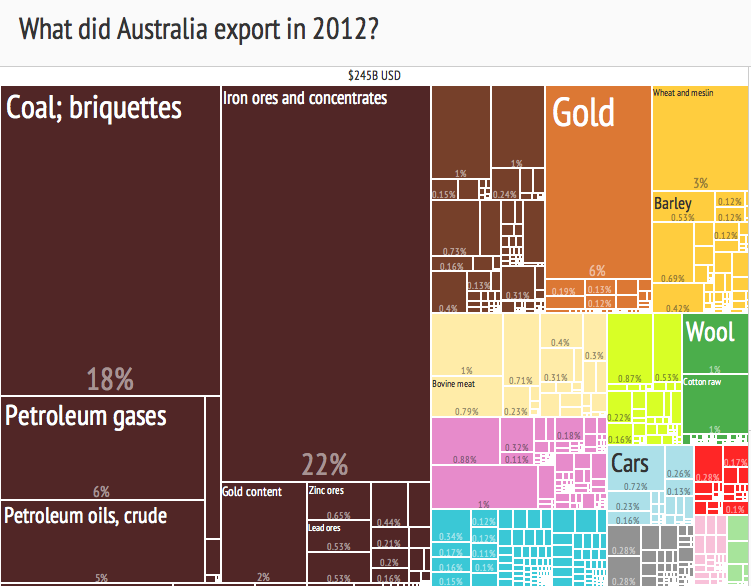
Long term the Aussie$ has nowhere to go but down. The US will be raising rates while Australia is forced to keep rates on hold with the fall-off in mining investment hitting the economy hard and with the RBA trying to engineer a soft landing to prevent a huge calamity thanks to our massive level of personal debt that has been used to bid up house prices.
Needless to say, if there are any hiccups with the Chinese economy then things will go from bad to worse very quickly for the AUD.
With a growing population, increasing energy and food costs, a slowing economy, decaying infrastructure, accelerating unemployment and a critical lack of competitiveness against low cost and technologically progressive economies, we could see the quality of life in Australia begin to drop.
Those of us with sufficient gold and silver, or offshore investments, should be relatively okay as long as things don't get too bad in the cities (or wherever we live). No guarantees though as social cohesion is lost and growing numbers of angry, disenfranchised, unemployed (and unemployable) residents decide to take what they believe they are entitled to.
In the end, the piper will be paid for decades of economic ineptitude and greed.
Long term the Aussie$ has nowhere to go but down. The US will be raising rates while Australia is forced to keep rates on hold with the fall-off in mining investment hitting the economy hard and with the RBA trying to engineer a soft landing to prevent a huge calamity thanks to our massive level of personal debt that has been used to bid up house prices.
Needless to say, if there are any hiccups with the Chinese economy then things will go from bad to worse very quickly for the AUD.
With a growing population, increasing energy and food costs, a slowing economy, decaying infrastructure, accelerating unemployment and a critical lack of competitiveness against low cost and technologically progressive economies, we could see the quality of life in Australia begin to drop.
Those of us with sufficient gold and silver, or offshore investments, should be relatively okay as long as things don't get too bad in the cities (or wherever we live). No guarantees though as social cohesion is lost and growing numbers of angry, disenfranchised, unemployed (and unemployable) residents decide to take what they believe they are entitled to.
In the end, the piper will be paid for decades of economic ineptitude and greed.
Fears Australian dollar facing 'benign collapse' to $US66
The Australian dollar could face a "benign collapse" to US66 by the end of next year amid falling commodity prices, declining mining investment and reduced government spending, Deutsche Bank says in one of the most bearish forecasts for the local currency.
The plunge in the Australian dollar to the mid-US60 would come about if the Reserve Bank keeps interest rates on hold until 2016, if the US lifts its rates by mid-2015 and if the United States' dollar continues to strengthen, Deutsche Bank's chief economist for Australia Adam Boyton said.
..."Critically, we would view this as a benign 'collapse' in the Australian dollar; not one sparked by a domestic or offshore 'crisis'," Mr Boyton said in a research note, adding that the new projections fell below Deutsche Bank's current end-2015 forecast of US75.
..."A US65 number is quite possible in a negative scenario for China and much weaker commodity prices, and maybe a degree of financial stress in China, which has bigger global implications. Those are the kinds of things you need to get it down to those levels," Mr Gibbs said, adding that the Australian dollar had become a risk proxy for China.
He said it would be difficult for the Australian dollar to return to higher levels as mining companies keep their costs reined in and with improved business confidence driven by a lower exchange rate.
Mr Boyton's scenario for a mid-US60 came through a modelling of interest rate differentials between yields on 10-year US and Australian government bonds, one of the factors that drives the currency's movements.
...At the same time, the strengthening of the US dollar, which currency strategists expect to take place as the Fed withdraws its stimulus this year, would also contribute to the weakening local currency, Mr Boyton added. Deutsche Bank tips the US dollar to rise by 20 per cent against the euro and by 17 per cent against the Japanese yen over the next two years.
Deutsche Bank predicts that the Reserve Bank would keep the cash rate on hold at a record low of 2.5 per cent over the next two years, with the fall-off in mining investment hitting the economy harder in late 2014 and early 2015. Government spending is already projected to tighten in the later years of federal budget projections, while state government expenditure is also tipped to remain soft, forcing the central bank to maintain a loose monetary policy, the bank said.
http://www.smh.com.au/business/mark...g-benign-collapse-to-us66-20140224-33cfl.html