

“Back after World War I, the price of silver was going very high, there was a lot of instability around, and the government was even thinking about reducing the silver standard in coins.”
The Australian government, fearing five-shilling coins would become increasingly scarce as consumers hoarded them for the silver they contained, prepared the five-shilling banknotes, and more than one million were printed.
“But when the price of silver stabilised, they burned them in 1922, destroyed the whole printing,” Mr Noble said. The four surviving notes don’t have serial numbers but do have signatures, suggesting they were legally held by C.J. Cerutty as items to show to politicians, VIPs or the royal family.
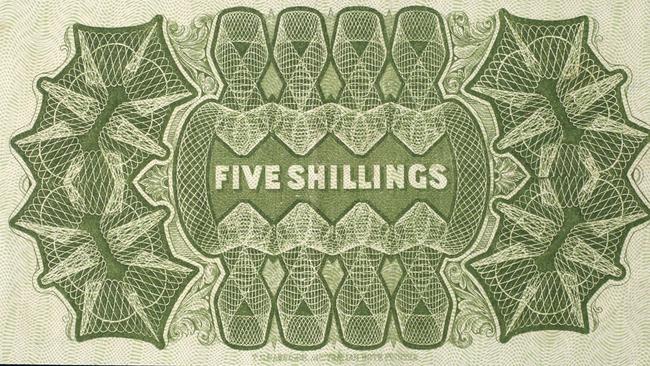
It’s one of only four known to exist.
Mr Noble said the circumstances surrounding the five-shilling note were “unprecedented”.
“The only other time they destroyed a lot of notes [was when] they destroyed 1000-pound notes in the 1960s, which they were holding as currency [to be used] between the official banks,” he said. “This is the only issue I know of that was printed and made ready for distribution.”
Unfortunately for the seller, he looks set to make an eye-watering loss. The note was purchased a number of years ago for more than $300,000 from Albany-based dealer The Rare Coin Company, which collapsed in 2013.
The West Australian reported many of its investors were retirees who accumulated coins and notes using self-managed superannuation funds (SMSF).
Changes to SMSF rules around art and collectibles which came into effect last year caused a massive sell-off in 2015 and 2016. The changes required regulator valuations, external third-party storage and higher insurance costs.
“There was a boom when superannuation was allowed,” said Mr Noble. “For your own private super, people could buy things, and some people did, [but they] didn’t know what they were buying. I guess he’s not smiling about it, that’s for sure.”
The auction is expected to attract between 50-100 bidders on each of the four days, together with thousands of international bidders through the online portal.
Other highlights include a rare gold sovereign issued in 1926 from the Sydney Mint, estimated at $45,000, a 10-pound banknote from 1925 — the only one to ever be offered at auction — estimated at $40,000, and a rare 1820 convict token used as an identity pass at the Richmond General Penitentiary in Ireland, built as an alternative to transportation to Tasmania.
“I’m excited about that,” Mr Noble said. “It’s never been seen by anyone in Australia or the UK.”
http://www.news.com.au/finance/supe...n/news-story/c3fbcf832a6809067b71d10b8bfa9928
The Australian government, fearing five-shilling coins would become increasingly scarce as consumers hoarded them for the silver they contained, prepared the five-shilling banknotes, and more than one million were printed.
“But when the price of silver stabilised, they burned them in 1922, destroyed the whole printing,” Mr Noble said. The four surviving notes don’t have serial numbers but do have signatures, suggesting they were legally held by C.J. Cerutty as items to show to politicians, VIPs or the royal family.
It’s one of only four known to exist.
Mr Noble said the circumstances surrounding the five-shilling note were “unprecedented”.
“The only other time they destroyed a lot of notes [was when] they destroyed 1000-pound notes in the 1960s, which they were holding as currency [to be used] between the official banks,” he said. “This is the only issue I know of that was printed and made ready for distribution.”
Unfortunately for the seller, he looks set to make an eye-watering loss. The note was purchased a number of years ago for more than $300,000 from Albany-based dealer The Rare Coin Company, which collapsed in 2013.
The West Australian reported many of its investors were retirees who accumulated coins and notes using self-managed superannuation funds (SMSF).
Changes to SMSF rules around art and collectibles which came into effect last year caused a massive sell-off in 2015 and 2016. The changes required regulator valuations, external third-party storage and higher insurance costs.
“There was a boom when superannuation was allowed,” said Mr Noble. “For your own private super, people could buy things, and some people did, [but they] didn’t know what they were buying. I guess he’s not smiling about it, that’s for sure.”
The auction is expected to attract between 50-100 bidders on each of the four days, together with thousands of international bidders through the online portal.
Other highlights include a rare gold sovereign issued in 1926 from the Sydney Mint, estimated at $45,000, a 10-pound banknote from 1925 — the only one to ever be offered at auction — estimated at $40,000, and a rare 1820 convict token used as an identity pass at the Richmond General Penitentiary in Ireland, built as an alternative to transportation to Tasmania.
“I’m excited about that,” Mr Noble said. “It’s never been seen by anyone in Australia or the UK.”
http://www.news.com.au/finance/supe...n/news-story/c3fbcf832a6809067b71d10b8bfa9928


