
Hi there, many thanks for all the questions that have been sent. Sorry that I can't always answer every question in great depth due to time constraints. Selling Pandas is not my occupation, but it certainly is a pleasure - not just because of the money, but because I enjoy sharing what I enjoy with others.
Since many questions are very similar, I have created this post to help answer them.
As a fellow Panda collector, I do enjoy sharing my experiences and enthusiasm about Panda collecting with others. I don't assume to be an expert compared to many other people (E.g. Panda Collector, Comeaux, Tamo42, 25Grizzlies, Fishball, Palm, Badon, etc). But hopefully this guide will be helpful to those wanting to know more about investing and collecting Pandas.
Before jumping straight to the questions though, consider whether you are likely to be a collector or investor (or both). A collectors strategy will be different from an investors strategy, though there are many commonalities between them. Both are profitable, and both are rewarding.
A Panda collector values the coin for the art that each coin contains, and while profit may be desired, it is not the ultimate objective. A collector often carefully selects and hunts for a specific Panda to complete a set, or due to some special appeal, etc.

A Panda investor values the coin for the profit it brings, and while he/she may appreciate the designs, profiting from the Pandas is the primary objective. An investor looks at the trends and probabilities and invests in the range of coins which he/she thinks is likely to bring the greatest profit.

Personally, I see myself as primarily an investor. My main objective is to profit from Pandas. I do have some Pandas that I collect and am unlikely to sell... but if the price was right, I would sell pretty much all my Pandas. I am not a dealer, nor do I earn a living selling Pandas. Yet, more and more Pandas are taking up my time. They certainly have been one of my more productive hobbies in life.
On the other hand, my wife is a collector. There are some Pandas she would not sell, unless she was reasonably assured she could get them back again. Some years hold special significance (e.g. When we first met, the year we got married, the year of our child, etc).
Question: Why collect/invest in Pandas as compared against other bullion coins?
Answer: There are many answers to this question, but here are some of my answers.
1. Pandas have been one of the most profitable bullion coins in the last decade to own. Some Pandas that have sold for $6-$8/oz are now fetching in excess of $1500/oz (E.g. 2000 Mirrored Pandas in Original Mint Packaging). Other Pandas, like the 1990 1oz Silver Panda when graded, can fetch up to $5200USD! The list of profitable Pandas goes on and on and on... and it is not just the really old Pandas. Even new Pandas that are only a few years old, like the 2009 and 2010 Pandas have appreciated more than most other bullion coins, and at rates faster than mere spot silver.

2. Pandas have proven to be relatively resistant to drops in spot (with exception to the current year release). The older the Panda, generally the more resistant to drops in spot. However, the higher the price of spot, the higher the value of the Panda.
Question: Why have Pandas performed so well?
Answer: Panda performance can be attributed to many things, but I believe it is primarily because of Demand and Supply.
a) Supply of older Pandas, especially pre-2000 Pandas are not growing, and many pre2000 Pandas are quite rare.
b) Demand for Pandas is growing. This demand is both local (Chinese) and international.
c) Supply of newer Pandas, especially post-2010 Pandas, are growing by the millions, which is helping to create new Panda collectors.
Question: What about the fake Pandas?
Answer:
a) Yes, fake Pandas exist, but these are easy to avoid if you stick to reliable sources. It also helps to do your homework. I haven't yet come across a convincing fake, and I have probably seen more Pandas than most people. That being said, there are people who claim to have seen fake Pandas that are virtually indistinguishable from the genuine article... I have my doubts, but I could be wrong.
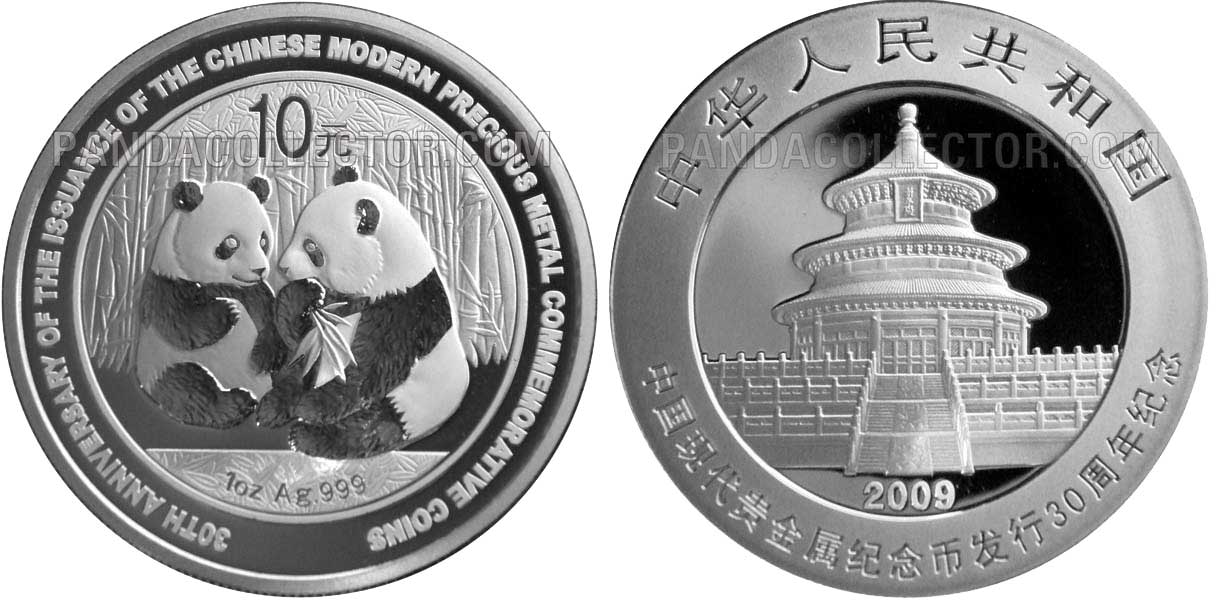 - genuine
 - fake
b) There is a reason why people fake Pandas... it is because they are profitable.
c) Many people worry that fake Pandas will drive down the price of Pandas. I don't worry about that too much, if fake Pandas were such a big issue, Pandas would not have performed as well as they have over the past 10years and longer.
d) There exists a community dedicated to exposing bad bears and bad bear dealers that is very helpful located at the China Coin Forum.
e) Microsoft is probably the most counterfeited software in the world, and yet it is one of the most profitable software companies. The USD is probably the most counterfeited note in the world, and yet it is the most widely accepted. Counterfeit Pandas for me are just an annoying fact of life, that anything of significant value is likely to be counterfeited.

Question: What are some profitable Panda strategies for investors?
Answer: Please understand, this is my opinion, and I don't control the markets, so don't hold me accountable if Pandas crash to below spot.
a) The simplest strategy to play in the Panda market is to buy 2011 1oz Silver Pandas. These are likely to have a small 1-5% rise above spot next year, since the 2012 Pandas will be the next bullion Pandas. Over 10years, no one can be sure what prices these will achieve, but it is highly likely they will be worth more than the then current 2022 Panda bullion.
[imgz=http://forums.silverstackers.com/uploads/675_img_0196s.jpg]
 [/imgz][imgz=http://forums.silverstackers.com/uploads/675_img_0207s.jpg]
 [/imgz]
b) Alternatively, for those that want to try something a bit more speculative, target older and rarer Pandas that are likely to become even more rare in the coming months and years. Without a doubt, my favorite play has been the BIG3 (the 3 rarest silver Pandas from 1989-2011), which are the 2000 Mirror, the 1995 Microdate, and the 1999 Serif. The number of Panda collectors and investors are unlikely to diminish in the next 5-10years, which means that the top end of Pandas are likely to be in constant demand.
[imgz=http://forums.silverstackers.com/uploads/675_img_2502.jpeg]
 [/imgz][imgz=http://forums.silverstackers.com/uploads/675_1995remd.jpg]
 [/imgz][imgz=http://forums.silverstackers.com/uploads/675_1999re.jpeg]
 [/imgz]
c) I like charts because in my opinion past performance is the best indicator of future performance. I like the correlation of low mintages + older age = high value. Thus, I tend to target the Pandas which seem to be undervalued, yet exhibit low mintage and older age (e.g. Good quality 2001, and 2002s are in my opinion both hard to find and currently undervalued).
[imgz=http://forums.silverstackers.com/uploads/675_19892000pandapoppricing.png]
 [/imgz][imgz=http://forums.silverstackers.com/uploads/675_19892000pandapoppricingnobig3.png]
 [/imgz][imgz=http://forums.silverstackers.com/uploads/675_20012011pandapoppricing.png]
 [/imgz][imgz=http://forums.silverstackers.com/uploads/675_img_2229.jpeg]
 [/imgz]
Question: What are some profitable Panda strategies for collectors?
Answer: Talk to 25Grizzlies, Comeaux and Panda Collector.
a) The biggest profits are probably going to be found amongst the Panda collectors. 25Grizzlies has shared with the SydneyStackers some of his strategies for selecting Pandas that he sees as undervalued and likely to rise significantly.


b) Rare pandas such as the bi-metallics.
[imgz=http://forums.silverstackers.com/uploads/675_img_2295.jpeg]
 [/imgz]
c) Proof Pandas.
[imgz=http://forums.silverstackers.com/uploads/675_1990pf.jpg]
 [/imgz]
Question: Will some Pandas like the 1989s (or other older Pandas besides the BIG3) ever perform really really well, like the BIG3 have?
[imgz=http://forums.silverstackers.com/uploads/675_1989buf.jpg]
 [/imgz]
Answer:
a) Possibly. I don't think we have seen the height of the Pandamonium... I estimate that there are currently about 100,000 average Panda collectors worldwide, with a hardcore Panda collecting element of about 20,000 people. As more and more people start investing and collecting Pandas, I believe we are going to see a situation where even Pandas which are considered common, start to become very rare (E.g. 1995 Short Twig Small Date, 2000 Frosted, etc). This is unlikely to happen within the next few months, but it may happen in a few years.
b) In the case of the 1989 Panda, every average Panda collector is likely to have one of these because it is the first Panda of the 1989-2011 series. It is estimated that there are 184,000 of these 1989 Pandas available. So once the Pandamonium kicks in, and the Panda collector base swells to 200,000; I think it is reasonable to see the price of the 1989 shoot much higher than a 2011, 2010, 2009, etc.
c) The BIG3 will likely perform above the 1989 (in my opinion and hopes), but the risk is also greater.
Question: What is SD, LD, Frosted, Mirrored, ST, Serif, etc?
Answer: There are 3 mints that make Pandas. For some Panda years (most of them), there are slight variations in font, or date size, etc. Usually the Panda variation with lowest population appreciates the fastest.
[imgz=http://forums.silverstackers.com/uploads/675_img_6847.jpeg]
 [/imgz]
SD - Small Date
LD - Large Date
Frosted - In 2000, the Pandas came in two varieties, one with a Frosted outer ring, the other with a Mirrored outer ring. The Frosted 2000 BU Panda usually goes for above $500, while the Mirrored 2000 BU Panda goes for above $1500.
[imgz=http://forums.silverstackers.com/uploads/675_2005bur.jpeg]
 [/imgz][imgz=http://forums.silverstackers.com/uploads/675_2000re.jpeg]
 [/imgz]
ST - Short Twig. In 1995, there were three varieties of Pandas. One variety of Panda was seen eating a 9 leaf bamboo cane (it also had a large date - RRP: $125). Another variety of Panda was seen eating a 3 leaf bamboo cane (it had a small date - RRP: $145). But finally a very rare Panda was seen eating a 3 leaf bamboo cane with a micro date (RRP: $2995)
[imgz=http://forums.silverstackers.com/uploads/675_1995ob.jpeg]
 [/imgz][imgz=http://forums.silverstackers.com/uploads/675_1995re.jpeg]
 [/imgz]
Serif - In 1999 it was found that only a few select bears had the serif font used for their date.
[imgz=http://forums.silverstackers.com/uploads/675_1999re.jpg]
 [/imgz][imgz=http://forums.silverstackers.com/uploads/675_1999ob.jpg]
 [/imgz]
If you have any further questions, please don't hesitate to pm me.
Many thanks for your interest in Pandas,
Yennus.
Since many questions are very similar, I have created this post to help answer them.
As a fellow Panda collector, I do enjoy sharing my experiences and enthusiasm about Panda collecting with others. I don't assume to be an expert compared to many other people (E.g. Panda Collector, Comeaux, Tamo42, 25Grizzlies, Fishball, Palm, Badon, etc). But hopefully this guide will be helpful to those wanting to know more about investing and collecting Pandas.
Before jumping straight to the questions though, consider whether you are likely to be a collector or investor (or both). A collectors strategy will be different from an investors strategy, though there are many commonalities between them. Both are profitable, and both are rewarding.
A Panda collector values the coin for the art that each coin contains, and while profit may be desired, it is not the ultimate objective. A collector often carefully selects and hunts for a specific Panda to complete a set, or due to some special appeal, etc.
A Panda investor values the coin for the profit it brings, and while he/she may appreciate the designs, profiting from the Pandas is the primary objective. An investor looks at the trends and probabilities and invests in the range of coins which he/she thinks is likely to bring the greatest profit.
Personally, I see myself as primarily an investor. My main objective is to profit from Pandas. I do have some Pandas that I collect and am unlikely to sell... but if the price was right, I would sell pretty much all my Pandas. I am not a dealer, nor do I earn a living selling Pandas. Yet, more and more Pandas are taking up my time. They certainly have been one of my more productive hobbies in life.
On the other hand, my wife is a collector. There are some Pandas she would not sell, unless she was reasonably assured she could get them back again. Some years hold special significance (e.g. When we first met, the year we got married, the year of our child, etc).
Question: Why collect/invest in Pandas as compared against other bullion coins?
Answer: There are many answers to this question, but here are some of my answers.
1. Pandas have been one of the most profitable bullion coins in the last decade to own. Some Pandas that have sold for $6-$8/oz are now fetching in excess of $1500/oz (E.g. 2000 Mirrored Pandas in Original Mint Packaging). Other Pandas, like the 1990 1oz Silver Panda when graded, can fetch up to $5200USD! The list of profitable Pandas goes on and on and on... and it is not just the really old Pandas. Even new Pandas that are only a few years old, like the 2009 and 2010 Pandas have appreciated more than most other bullion coins, and at rates faster than mere spot silver.
2. Pandas have proven to be relatively resistant to drops in spot (with exception to the current year release). The older the Panda, generally the more resistant to drops in spot. However, the higher the price of spot, the higher the value of the Panda.
Question: Why have Pandas performed so well?
Answer: Panda performance can be attributed to many things, but I believe it is primarily because of Demand and Supply.
a) Supply of older Pandas, especially pre-2000 Pandas are not growing, and many pre2000 Pandas are quite rare.
b) Demand for Pandas is growing. This demand is both local (Chinese) and international.
c) Supply of newer Pandas, especially post-2010 Pandas, are growing by the millions, which is helping to create new Panda collectors.
Question: What about the fake Pandas?
Answer:
a) Yes, fake Pandas exist, but these are easy to avoid if you stick to reliable sources. It also helps to do your homework. I haven't yet come across a convincing fake, and I have probably seen more Pandas than most people. That being said, there are people who claim to have seen fake Pandas that are virtually indistinguishable from the genuine article... I have my doubts, but I could be wrong.
b) There is a reason why people fake Pandas... it is because they are profitable.
c) Many people worry that fake Pandas will drive down the price of Pandas. I don't worry about that too much, if fake Pandas were such a big issue, Pandas would not have performed as well as they have over the past 10years and longer.
d) There exists a community dedicated to exposing bad bears and bad bear dealers that is very helpful located at the China Coin Forum.
e) Microsoft is probably the most counterfeited software in the world, and yet it is one of the most profitable software companies. The USD is probably the most counterfeited note in the world, and yet it is the most widely accepted. Counterfeit Pandas for me are just an annoying fact of life, that anything of significant value is likely to be counterfeited.
Question: What are some profitable Panda strategies for investors?
Answer: Please understand, this is my opinion, and I don't control the markets, so don't hold me accountable if Pandas crash to below spot.
a) The simplest strategy to play in the Panda market is to buy 2011 1oz Silver Pandas. These are likely to have a small 1-5% rise above spot next year, since the 2012 Pandas will be the next bullion Pandas. Over 10years, no one can be sure what prices these will achieve, but it is highly likely they will be worth more than the then current 2022 Panda bullion.
[imgz=http://forums.silverstackers.com/uploads/675_img_0196s.jpg]
b) Alternatively, for those that want to try something a bit more speculative, target older and rarer Pandas that are likely to become even more rare in the coming months and years. Without a doubt, my favorite play has been the BIG3 (the 3 rarest silver Pandas from 1989-2011), which are the 2000 Mirror, the 1995 Microdate, and the 1999 Serif. The number of Panda collectors and investors are unlikely to diminish in the next 5-10years, which means that the top end of Pandas are likely to be in constant demand.
[imgz=http://forums.silverstackers.com/uploads/675_img_2502.jpeg]
c) I like charts because in my opinion past performance is the best indicator of future performance. I like the correlation of low mintages + older age = high value. Thus, I tend to target the Pandas which seem to be undervalued, yet exhibit low mintage and older age (e.g. Good quality 2001, and 2002s are in my opinion both hard to find and currently undervalued).
[imgz=http://forums.silverstackers.com/uploads/675_19892000pandapoppricing.png]
Question: What are some profitable Panda strategies for collectors?
Answer: Talk to 25Grizzlies, Comeaux and Panda Collector.
a) The biggest profits are probably going to be found amongst the Panda collectors. 25Grizzlies has shared with the SydneyStackers some of his strategies for selecting Pandas that he sees as undervalued and likely to rise significantly.
b) Rare pandas such as the bi-metallics.
[imgz=http://forums.silverstackers.com/uploads/675_img_2295.jpeg]
c) Proof Pandas.
[imgz=http://forums.silverstackers.com/uploads/675_1990pf.jpg]
Question: Will some Pandas like the 1989s (or other older Pandas besides the BIG3) ever perform really really well, like the BIG3 have?
[imgz=http://forums.silverstackers.com/uploads/675_1989buf.jpg]
Answer:
a) Possibly. I don't think we have seen the height of the Pandamonium... I estimate that there are currently about 100,000 average Panda collectors worldwide, with a hardcore Panda collecting element of about 20,000 people. As more and more people start investing and collecting Pandas, I believe we are going to see a situation where even Pandas which are considered common, start to become very rare (E.g. 1995 Short Twig Small Date, 2000 Frosted, etc). This is unlikely to happen within the next few months, but it may happen in a few years.
b) In the case of the 1989 Panda, every average Panda collector is likely to have one of these because it is the first Panda of the 1989-2011 series. It is estimated that there are 184,000 of these 1989 Pandas available. So once the Pandamonium kicks in, and the Panda collector base swells to 200,000; I think it is reasonable to see the price of the 1989 shoot much higher than a 2011, 2010, 2009, etc.
c) The BIG3 will likely perform above the 1989 (in my opinion and hopes), but the risk is also greater.
Question: What is SD, LD, Frosted, Mirrored, ST, Serif, etc?
Answer: There are 3 mints that make Pandas. For some Panda years (most of them), there are slight variations in font, or date size, etc. Usually the Panda variation with lowest population appreciates the fastest.
[imgz=http://forums.silverstackers.com/uploads/675_img_6847.jpeg]
SD - Small Date
LD - Large Date
Frosted - In 2000, the Pandas came in two varieties, one with a Frosted outer ring, the other with a Mirrored outer ring. The Frosted 2000 BU Panda usually goes for above $500, while the Mirrored 2000 BU Panda goes for above $1500.
[imgz=http://forums.silverstackers.com/uploads/675_2005bur.jpeg]
ST - Short Twig. In 1995, there were three varieties of Pandas. One variety of Panda was seen eating a 9 leaf bamboo cane (it also had a large date - RRP: $125). Another variety of Panda was seen eating a 3 leaf bamboo cane (it had a small date - RRP: $145). But finally a very rare Panda was seen eating a 3 leaf bamboo cane with a micro date (RRP: $2995)
[imgz=http://forums.silverstackers.com/uploads/675_1995ob.jpeg]
Serif - In 1999 it was found that only a few select bears had the serif font used for their date.
[imgz=http://forums.silverstackers.com/uploads/675_1999re.jpg]
If you have any further questions, please don't hesitate to pm me.
Many thanks for your interest in Pandas,
Yennus.


